


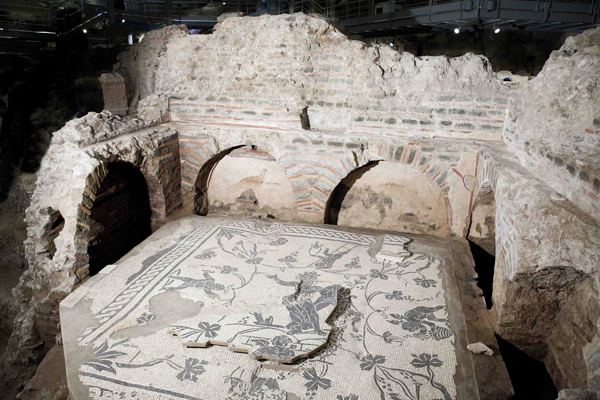


An ancient cemetery, located underneath Vatican City and containing the graves of some of the earliest Roman Christians, will soon be open to the public for the first time. It’s well preserved and presents a fascinating view of the lives and traditions of middle- and lower-class Romans between around 80 B.C. and 320 A.D. Photo courtesy of Vatican Museum
VATICAN CITY (RNS) In the first century B.C., a grassy hillside just north of what is now St. Peter’s Square was used as a burial place for local Romans.
It remained in use through dozens of mudslides and avalanches, until the early fourth century A.D., when work on St. Peter’s Basilica began and the more than 1,000 graves were covered over. Soon after, it was forgotten as the construction of the Vatican City grew up around it.
It remained that way until the 1950s, when plans to build a parking lot on what appeared to be an undeveloped field uncovered a small part of the 10,000-square-foot necropolis, or cemetery. That’s when excavations began.
Now, two generations and hundreds of thousands of dollars later, the Vatican is ready to let the public see what it uncovered.
The Roman Necropolis of the Via Triumphalis illustrates changing burial traditions and the city’s evolution from a pagan capital into its earliest days as a Christian city. Overseers say it is likely a small handful of those buried — no more than 50 of the 1,000 graves — may have belonged to early Christians.
“The area was constantly reborn between its establishment in the first century B.C. to around 300 or 320 A.D.,” said Giandomenico Spinola, an archaeologist specializing in Greek and Roman periods and the curator of the Vatican necropolis.
Mudslides and avalanches helped preserve much of what has been uncovered. Many items in the cemetery are unusually well preserved: Some marble statues still bear signs of paint; a child’s remains show he still clenches a coin placed between his teeth according to the burial traditions of the time.
There was a period when the dead were cremated, with ashes and bone fragments placed in urns buried at the site, and other periods when the deceased were buried in elaborate plots complete with personal belongings and other symbols of social stature.
The site is unusual because poor and middle-class Romans used it. Most well-preserved cemeteries in Rome consist of burial sites of the noble and wealthy classes of the day.
“It’s a fascinating way to view and learn something about this very important period,” said Spinola. “We’re just beginning to digest the value of what we’ve unearthed here.”
The parking lot that led to the discovery of the cemetery in the 1950s has since been completed. The unlikely position of the site, under the parking lot and surrounded by administrative buildings, makes the view of the excavations even more surprising.
Excavations are ongoing, just as they have been since 1956 — the main difference is that starting Feb. 3, the public will be able to take in the site. Reservations are required via the Vatican Museums website.
YS/AMB END LYMAN