





(RNS) National attention on a proposed Arizona law allowing business owners to deny service for religious reasons to gay people signals how attitudes on social issues have shifted dramatically in recent years.
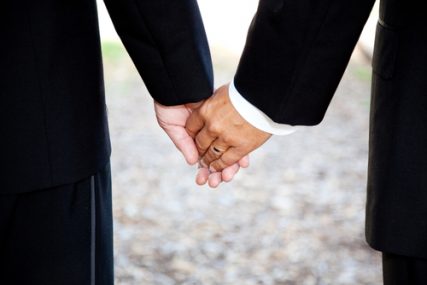
Closeup of a same-sex couple holding hands, wearing a wedding ring.
Experts said such changes will accelerate on issues such as same-sex marriage, interracial marriage, legalization of marijuana and childbearing among the unwed. Younger people are more liberal and less conventional, they said.
“We’re entering a period of massive social change,” said sociologist Daniel Lichter, of Cornell University in Ithaca, N.Y. “This traditional pattern is reinforced by very large racial changes in America’s composition. The Baby Boomer generation — which is predominantly white and affluent and in some ways, conservative — in the next 20 (to) 30 years will be replaced by a younger population, and that population is going to be disproportionately minority.”
Recent national polls detail seismic shifts, often in a matter of years. Among the changes:
- Same-sex marriage: A 1996 Gallup poll on same-sex marriage found 27 percent in favor and 68 percent opposed. A USA TODAY poll last year found 55 percent supportive and 40 percent opposed.
- Interracial marriage: A USA TODAY/Gallup poll in 2011 found that 86 percent of Americans approved, compared with 48 percent in 1991.
- Legalization of marijuana: A 2013 Pew Research Center survey found 52 percent supporting legalization and 45 percent opposed. A 1969 Gallup survey found 12 percent favored legalization and 84 percent opposed. Pew also found marked generational differences, with 65 percent of Millennials (born 1980-early 2000s) in favor (up from 36 percent in 2008). Among older generations, the percentage of 65 and older who favor legalization has nearly doubled — from 17 percent to 32 percent — since 2002.

A woman smoking marijuana.
- Cohabitation: A 1981 ABC News/Washington Post poll found 45 percent disapproved and 40 percent approved of unmarried men and women living together without being married. In 2007, a similar USA TODAY/Gallup poll found 55 percent approved of such couples, while 27 percent disapproved.
- Births to unmarried couples: The share of the nation’s children younger than 18 living with cohabiting parents rose from 3 percent in 1990 to 6 percent in 2008, Census Bureau data show.
- Same-sex couples raising children: A 2007 Pew survey found that 50 percent of adults said that gay and lesbian couples raising children was bad for society, compared with 43 percent in a similar Pew survey in 2010.
“The social agenda has moved much more toward tolerance and acceptance,” said Paul Taylor, executive vice president of the Pew Research Center.
Taylor, author of “The Next America: Boomers, Millennials, and the Looming Generational Showdown,” a book out March 4, says the change is fueled by generational replacement and Millennials coming of age and asserting themselves.
“On something like gay marriage, where we’ve seen such dramatic change in just the last 10 or 15 years, one reason is opponents of gay marriage are literally dying off,” he said. “The very oldest in their 70s and 80s and beyond grew up in (an) America where cultural norms were different.”
(Sharon Jayson writes for USA Today.)
YS END JAYSON