


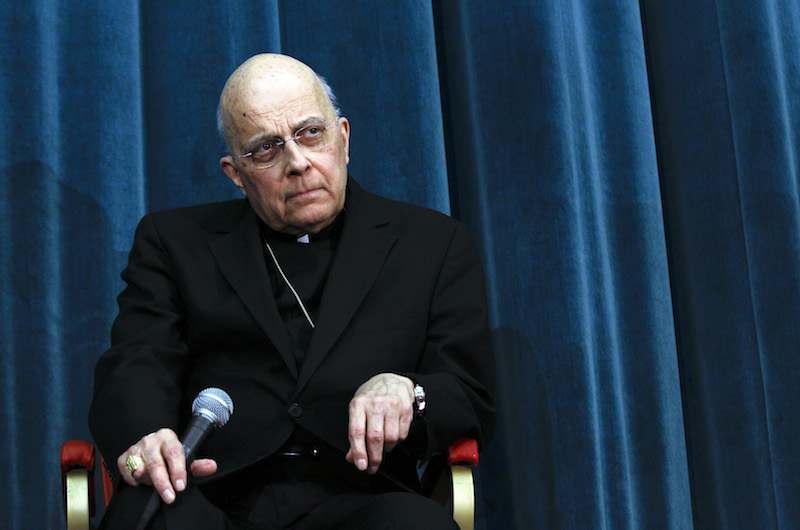


American Cardinal Francis George, archbishop of Chicago, attends a news conference at the North American College in Rome on March 4, 2013.
Photo courtesy of REUTERS/Alessandro Bianchi
(RNS) It’s a safe bet that Cardinal Francis George, who died in April after a long battle with cancer, would not have been happy with the recent Supreme Court decision legalizing gay marriage.
The former archbishop of Chicago was long known as a staunch conservative who was notably outspoken against gay marriage. In 2012 he had to apologize for comparing a gay pride parade going past a Catholic parish to a Ku Klux Klan march.
But was the cardinal privately open to the possibility that the Catholic Church could change its positions?
That’s the sense that an old friend of George’s got from a letter the cardinal sent him back in 2013, a note that Maurice Monette published last month at the blog of New Ways Ministry, which advocates for the acceptance of LGBT Catholics in the church.
Like Cardinal George, Monette was a priest of the Order of Mary Immaculate. But Monette left the order, and the priesthood, to marry his husband. He wrote a book about his life, “Confessions of a Gay Married Priest: A Spiritual Journey,” and about his hopes for more openness to gays by the Catholic Church.
Monette sent a copy to George, who he had known since the 1980s, when George would would argue for his conservative views, including his belief that gay men should not be allowed to be priests.
Yet the letter George sent back to Monette in December 2013 reflects the churchman who was often much more affable and engaging than his rather astringent public persona would suggest (it’s not for nothing he was known in Chicago as “Francis the Corrector”).
Monette admits he was “surprised” by the kindness, and also the content:
“It was good to hear the tone of happiness that underlies the presentation of your life. It was good also to get the sense that you have resolved things without bitterness and are free to continue the journey. All this I deeply appreciate,” George wrote.
The cardinal continued:
“As you yourself said in your note to me, my perspective on the path taken is different from yours. Nonetheless, with you, I agree that we need to keep listening to each other rather than speaking at cross-purposes. The categories of explanation of human experience are many and, as I’m sure you know, I can’t fit all your actions into the sense of things that I believe we have been given through Divine Revelation, even as I know that there is development in interpretation of events and of doctrine.”
Hmmm … “Development” and “doctrine” in the same sentence are red flags for many who read that as an opening to CHANGE. Which of course the church can never do — except when it does. As it is always doing.
George’s comments are also a contrast to the note that many bishops struck (publicly) when the gay marriage decision came down, and Monette writes that “The words of the Cardinal offer me hope that leadership in the Catholic Church is also moving in the direction of justice and love.”
Certainly, George’s meaning and intent will be open to interpretation. But his support for listening and engagement seems like an approach going forward, for both sides.
END GIBSON