


Who is the ‘Laughing Buddha’? A scholar of East Asian Buddhism explains


(The Conversation) — With his delighted expression, round belly, bald head and monastic robes, the “Laughing Buddha” is instantly identifiable. However, astute observers might wonder why this buddha does not look like the historical Buddha, who lived in India about 2,500 years ago.
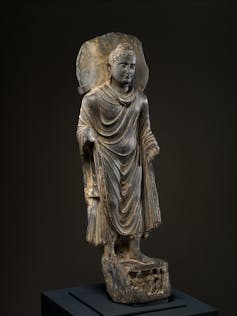
A third-century standing Buddha statue, from ancient Gandhara, in Pakistan.
Metropolitan Museum of Art
Images of the historical Buddha, known as Siddhartha Gautama or Shakyamuni, depict him with a neutral expression, slim build, tightly coiled hair and monastic robes. If the Laughing Buddha isn’t the historical Buddha, who is he, and how did he become so popular?
As a scholar of East Asian Buddhism who studies how and why deities transform over time, I see the Laughing Buddha as a key figure that shows how people have adapted Buddhism to different cultural and historical contexts.
The Zen monk who became the Laughing Buddha
One of the names for the Laughing Buddha is “Cloth Bag,” which is pronounced “Budai” in Chinese and “Hotei” in Japanese. Cloth Bag was the nickname of a Chinese Buddhist monk who lived in the 10th century. He belonged to the Zen school of Buddhism, which is known for its stories about monks who reject conventional pursuits like wealth and fame.
Cloth Bag got his nickname because he wandered from town to town carrying a cloth bag full of treasures that he shared freely with children.
Chinese Buddhists, seeing Cloth Bag’s legendary generosity, compassion and joy, concluded that he must not be an ordinary monk, but that he must be a human incarnation of the future Buddha, whose name is Maitreya. Artists in China depicted Cloth Bag as a plump, laughing monk often surrounded by children or animals. In a traditional East Asian context, his round belly represents his generosity and abundance, and also symbolizes the positive qualities of wealth and fertility.
From China, images of Cloth Bag as the Laughing Buddha traveled in two directions. They spread first in East Asia to countries such as Vietnam, Korea and Japan. Zen is a popular form of Buddhism in all of these countries, but it was Japanese Zen Buddhism that attained global popularity in the 19th and 20th centuries. This means that many images of the Laughing Buddha in the West are based on Japanese models.
Displaying Chinese porcelain
Images of the Laughing Buddha also spread west from China to Europe, where 18th-century elites showed their aesthetic sophistication by displaying Chinese-style porcelain, including statues of the Laughing Buddha.
The Laughing Buddha’s transformation into a global icon results from both the fascination with Chinese porcelain in 18th-century Europe and the 20th-century spread of Japanese Zen Buddhism.
Today we see the Laughing Buddha in stores, homes and even as a brand name. A lot of people may know what the Laughing Buddha looks like, but few may be familiar with who he is or how he became so popular.
(Megan Bryson, Associate Professor of Religious Studies, University of Tennessee. The views expressed in this commentary do not necessarily reflect those of Religion News Service.)
