

Timothy Snyder On Religion, Power, and Freedom
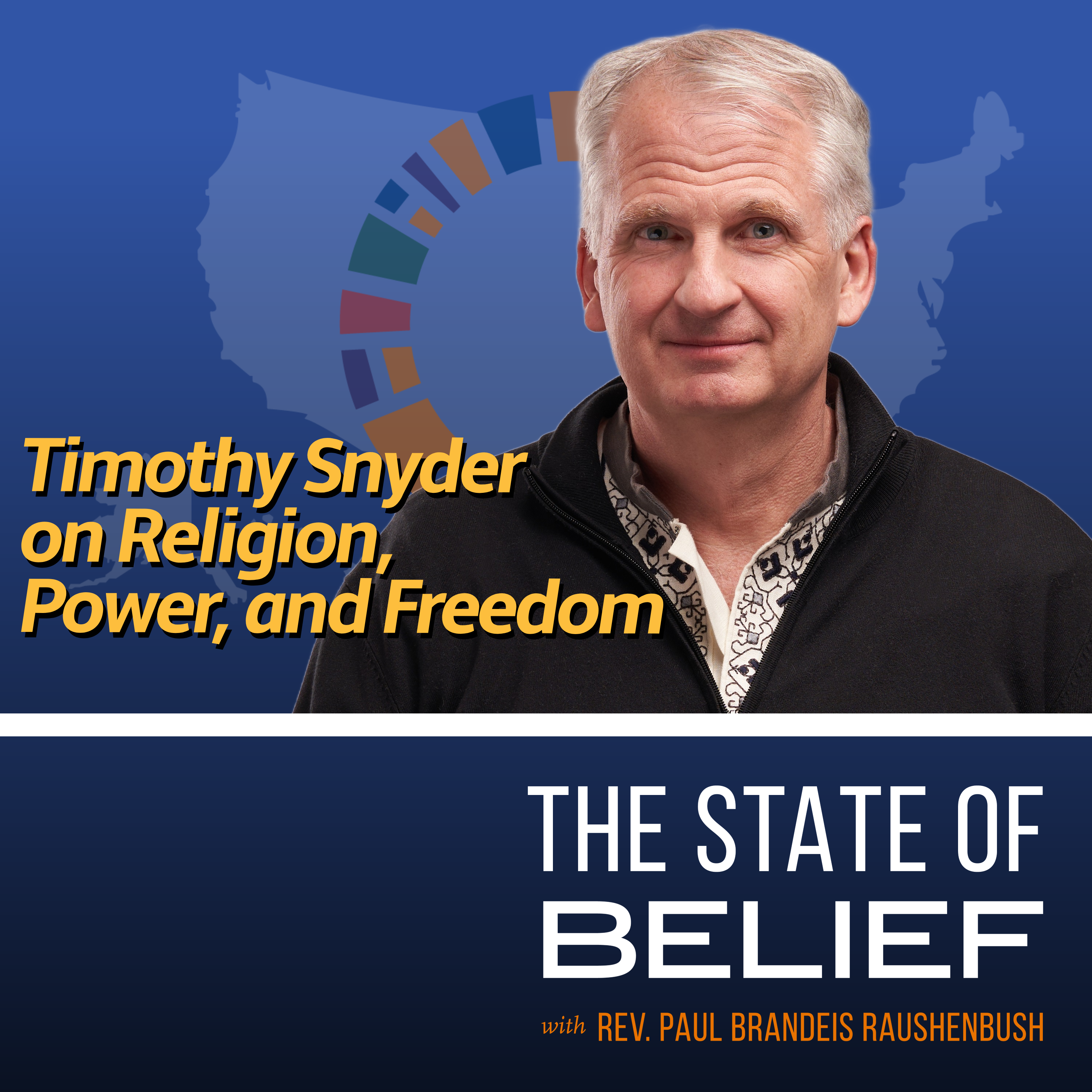


This week, renowned historian and author Timothy Snyder joins host Rev. Paul Brandeis Raushenbush to discuss the complex relationship between religion, freedom, and democracy. His new book, On Freedom, explores what freedom truly means, how it has been misunderstood, and why it is critical for our collective survival. It debuted as an instant New York Times best-seller, and has earned praise from leading figures like journalist and historian Anne Applebaum and Ukrainian President Zelenskyy.
In their conversation, Timothy and Paul discuss how religion can positively help people understand what is “good” by guiding them toward values like mercy, grace, and consistency. These values, they agree, support the fundamentally democratic idea that no one is free unless everyone is free.
“You can’t have freedom without a notion of what is good, and one thing that religion serves people is as a metaphysical source. Religion can offer notions of what is good – not the only ones, and certainly not ones that can’t be challenged by other religions or by people who are not religious. But religion can be a source of metaphysical commitment. It can lead you to caring about things like consistency or grace or mercy, and those things are necessary for freedom. So I’m not saying religion is necessary for freedom, but I’m saying that there’s a fundamental way in which a religious commitment can actually help with freedom – so long as that you recognize that on this earth, those things clash.”
– Dr. Timothy D. Snyder, renowned historian and professor of history at Yale University, specializing in modern European history, with a focus on authoritarianism, Ukraine and the Holocaust. His many influential books include Bloodlands: Europe Between Hitler and Stalin, and On Tyranny: Twenty Lessons from the Twentieth Century. He has held fellowships at the Centre Nationale des Recherches Scientifiques, Paris (1994-1995); the Harvard University’s Olin Institute for Strategic Studies (1997); served as an Academy Scholar at Harvard’s Center for International Affairs (1998-2001); and has held multiple fellowships at the Institut für die Wissenschaften vom Menschen in Vienna.
But, of course, producing this journalism carries a high cost, to support the reporters, editors, columnists, and the behind-the-scenes staff that keep this site up and running. That's why we ask that if you can, you consider becoming one of our donors. Any amount helps, and because we're a nonprofit, all of it goes to support our mission: To produce thoughtful, factual coverage of religion that helps you better understand the world. Thank you for reading and supporting RNS.