


(RNS) — As December begins, we want to start looking forward to celebrating a joyful Christmas. Doing so is tough with wars still in Ukraine and the Middle East. The world situation is so bleak, some are tempted to give up hope.
The Christian Advent is full of hope, but it also reminds us that we have to work to prepare the way for the Lord, not just wait passively for his coming.
As a result, it was appropriate for Pope Leo XIV to begin Advent with a visit to Turkey and Lebanon, which are in need of hope and commitment for peace. This was not the original Vatican plan. Pope Francis was supposed to go to Turkey in May to celebrate the 1,700th anniversary of the Council of Nicaea, but his death postponed any papal trip. But visiting in Advent provided Pope Leo the opportunity to give us some hope by calling for unity and peace.
In his homily for the first Sunday of Advent, the pope referred to the first reading (Isaiah 2:1-5) as “one of the most beautiful passages in the Book of the Prophet Isaiah, where the invitation resounds, beckoning all peoples to ascend the mountain of the Lord (cf. v. 3), a place of light and peace.”
Isaiah urges his listeners to “climb the Lord’s mountain, to the house of the God of Jacob, that he may instruct us in his ways, and we may walk in his paths.”
Speaking to a multinational congregation in Istanbul’s Volkswagen Arena, the pope said that Zion, the city set on the mountain, is a “symbol of a community reborn in fidelity. Its beauty is a beacon of light for men and women from every place, and serves as a reminder that the joy of goodness is contagious.” He gives the example of saints such as Peter who “meets Jesus thanks to the enthusiasm of his brother Andrew (John 1:40-42), who was led to the Lord, along with the Apostle John, by John the Baptist’s zeal.”
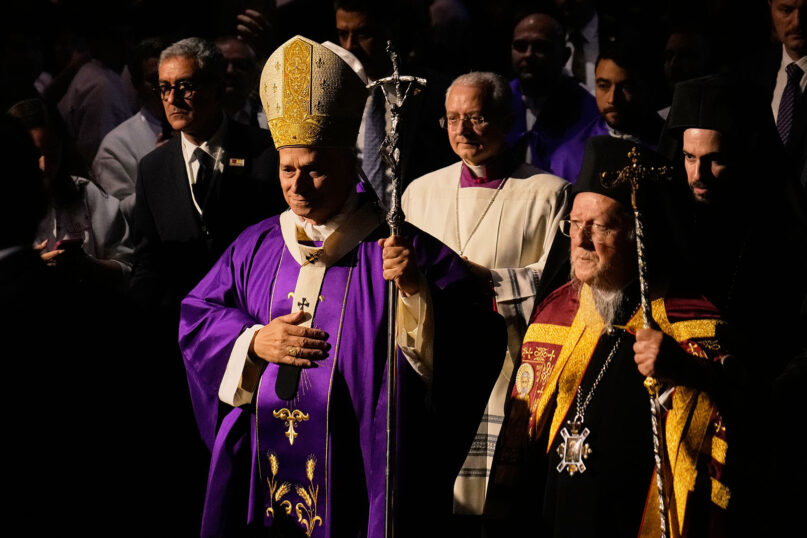
Pope Leo XIV arrives with Ecumenical Patriarch Bartholomew I, the spiritual leader of the world’s Eastern Orthodox Christians, to celebrate a Mass at the Volkswagen Arena, in Istanbul, Nov. 29, 2025. (AP Photo/Khalil Hamra)
The pope said he agrees with St. John Chrysostom, who said that the example of the saints attracts more people to Christ than miracles.
Joy, fidelity, goodness and love are contagious. Example is more powerful than words or miracles.
“If we truly want to help the people we meet,” Leo said, “let us ‘keep watch’ over ourselves, as the Gospel recommends (Matthew 24:42), by cultivating our faith with prayer, with the sacraments, living it consistently in charity and casting off — as St. Paul tells us in the second reading — the works of darkness and putting on the armor of light (Romans 13:12).”
Leo then focused on Isaiah’s call for a world at peace. “How urgent this call is for us today,” he said. “How great the need for peace, unity and reconciliation around us, within us and among us. What can our contribution be in response?”
Using the example of the three bridges that cross the Bosphorus Strait and unite Asia and Europe, Leo called for greater unity within the Catholic Church, among Christians and among people of all religious faiths.
First, he focused on the diversity and unity of the Catholic Church with its different liturgical traditions — Latin, Armenian, Chaldean and Syriac. “Each one contributes its own spiritual, historical and ecclesial richness,” he explained. “The sharing of these differences clearly demonstrates one of the most beautiful features of the face of the Bride of Christ: a catholicity that unites.”

Pope Leo XIV and Ecumenical Patriarch Bartholomew I, the spiritual leader of the world’s Eastern Orthodox Christians, lead an ecumenical prayer service at archaeological excavations of the ancient Byzantine-era Christian St. Neophytos Basilica, in Iznik, Turkey, Nov. 28, 2025, marking the 1,700th anniversary of the Council of Nicaea. (AP Photo/Khalil Hamra)
But such unity is not automatic: “Like the bridges over the Bosphorus, unity needs care, attention and maintenance, so that its foundations remain solid and are not weakened by time and vicissitudes,” he said. “Let us make every effort, then, to foster and strengthen the bonds that unite us, so that we may enrich one another and be a credible sign before the world of the Lord’s universal and infinite love.”
Second, the pope noted, “the same faith in Jesus our Savior unites not only those of us within the Catholic Church, but all our brothers and sisters belonging to other Christian churches.” This theme was especially evident a day earlier when he celebrated the 1,700th anniversary of the Council of Nicaea and prayed with the Ecumenical Patriarch Bartholomew I and others who profess the Nicene Creed.
In his homily, Leo united himself with Pope John XXIII, who at the beginning of the Second Vatican Council repeated the prayer of Jesus “that they may all be one” (John 17:21).
Finally, Leo spoke of how God calls us to unity with non-Christians.
“We live in a world where religion is too often used to justify wars and atrocities,” the pope said. Referring to the First Letter of John, he reminded us, “Whoever does not love does not know God” (1 John 4:8).
“Therefore,” the pope urged, “we want to walk together by appreciating what unites us, breaking down the walls of prejudice and mistrust, promoting mutual knowledge and esteem in order to give to all a strong message of hope and an invitation to become ‘peacemakers’ (Matthew 5:9).”
The pope then asked us to “make these values our resolutions for the season of Advent and even more so for our personal and communal life.”
Fidelity to God’s call to love one another as brothers and sisters is the path to unity and peace. The pope’s hope is that “we may love God and our brothers and sisters with all our hearts in order to journey together and find ourselves one day united in the house of the Father,” he said.
This is the message the world needs this Advent. We need hope, but we also need commitment to prepare the way for the Lord by seeking reconciliation and peace with all our brothers and sisters around the world.