

Sidelined from legacy institutions, a movement centering Judaism outside Israel rises


(RNS) — A group of synagogues, nonprofits and small lay-led prayer communities previously on the margins of the Jewish establishment have formed a new association as an effort to better advocate for their emerging vision of Judaism in the 21st century.
The association, the Jewish Diaspora Movement, launched Monday (May 18), consists of 40 groups, mostly in North America, that are united in their rejection of Israel’s ethno-nationalist Judaism. Though not explicitly anti-Zionist, the association is committed to centering the diaspora, rather than Israel, and working toward the liberation of all people, it said in announcing the association.
“We joyfully view wherever we are in the entire world as our home and reject the vision of Judaism that is state-centric, militarist, ethno-nationalist,” said a news release announcing the new association.
The “founding minyan,” or quorum of groups, under the new umbrella includes Jewish Voice for Peace, the largest organization of anti-Zionists in the country, and Rabbis for Ceasefire, a coalition of rabbis that emerged in the wake of Israel’s war on Gaza. It also includes a constellation of synagogues and prayer groups, or chavurot, that have emerged in cities such as Boston, Chicago, Cleveland, Hartford, Minneapolis, New York, Los Angeles and Pittsburgh.
The Jewish Diaspora Movement has been in the works for several years and is yet another signal that the consensus that made Zionism a centerpiece of Jewish identity has broken down. A 2025 poll from the Jewish Federations of North America shows only about a third of American Jews between ages 18 and 34 identify as “Zionists” — a lower rate than in older polls, even as majority of Jews still believe Israel has a right to exist.

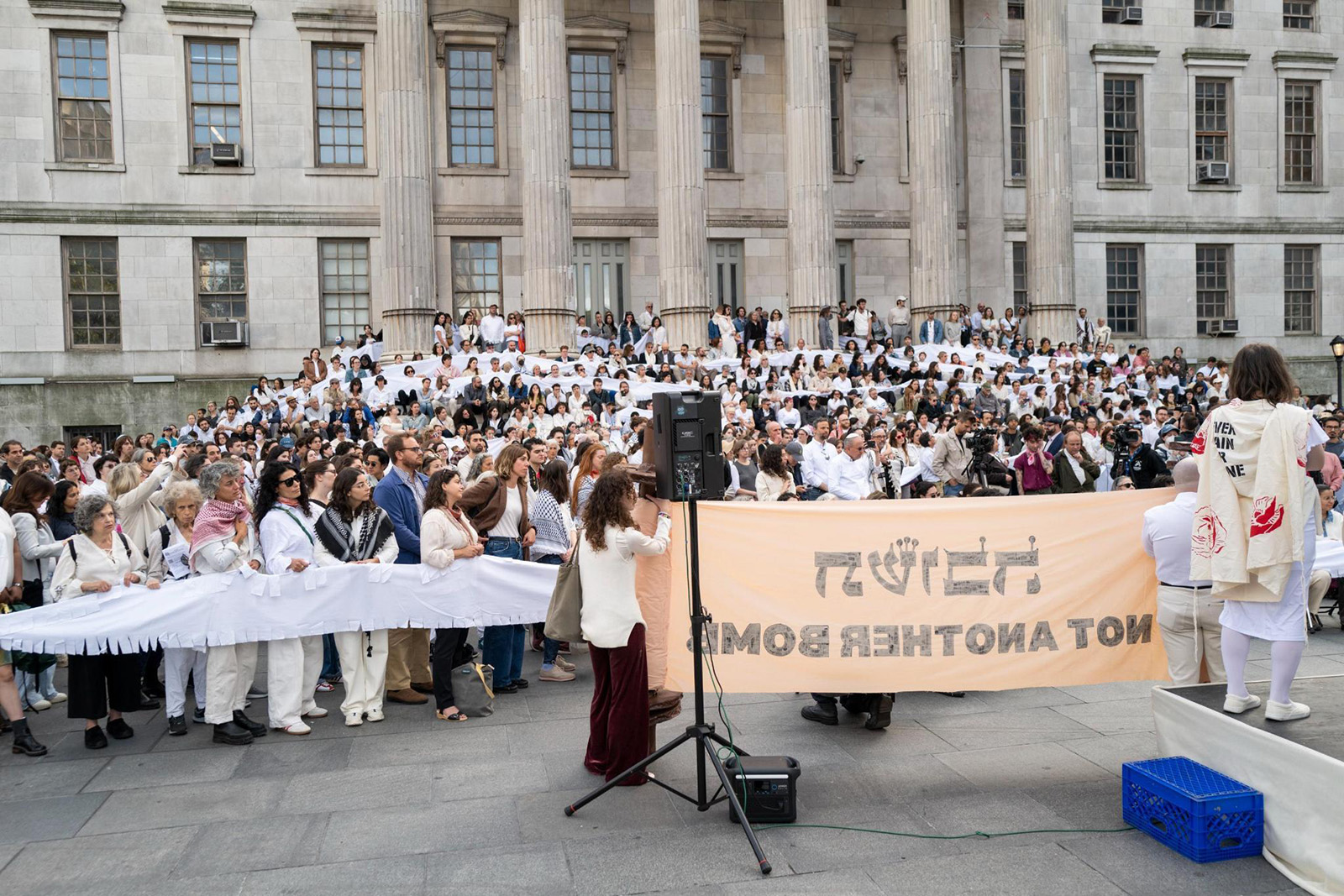
Demonstrators attend a “Seder in the Streets” event April 23, 2024, on Grand Army Plaza in Brooklyn, New York. The Passover-related protest was organized by Jewish Voice for Peace, IfNotNow and Jews for Racial and Economic Justice. (RNS photo/Fiona André)
RELATED: She was shunned for renouncing Zionism. A decade later, a rabbinical college is honoring her.
The movement also comes in response to U.S. Jewish legacy institutions’ unqualified support for Israel.
“We’re showing that we’re not a kind of random outlier out here, beyond the pale of what is considered ‘normal’ for Judaism today,” said Rabbi Andrue Kahn, executive director of the American Council for Judaism, one of the core members. “In fact, we are a part of a large network now of many organizations that hold the same values, that are saying this is what Judaism looks like and should continue to look like into the future.”

Jewish Diaspora Movement artwork by Sol Weiss. (Courtesy image)
Unlike legacy organizations, the new movement is structured in a democratic, horizontal format. There is no top executive. Big decisions will be made by referendum among the participating organizations. Everyday governance will be parceled out to committees and circles. Day to day, the association will consist of a so-called “spokescouncil.” So far, there is no paid staff, though that may change.
Rabbi Alissa Wise, one of the founders, said she expected the movement to grow beyond the initial 40 groups to include as many as 200 Jewish organizations around the world.
“The hope is that the launching of the movement will be an agitation,” Wise said. “Some organizations are going to have to take a risk if we’re going to have a different future.”
The movement is not intended to function as a denomination, and it will not exclude synagogues affiliated with the Reform, Conservative or Orthodox movements in the U.S.
Among the first synagogues to join is Kolot Chayeinu/Voices of Our Lives, an independent synagogue in Brooklyn, New York, that has been one of New York’s most progressive congregations, with more than 400 member families.
The synagogue, which fielded many supporters of New York City Mayor Zohran Mamdani’s successful election, does not take a position on Zionism, intentionally welcoming people of all beliefs. But it did want to be part of a larger constellation of Jewish congregations and nonprofits committed to finding an ethical Jewish path.
“Isolation has taken a huge toll, not just on our congregation or the Jewish community, but on our nation and many in the world,” said Rabbi Sam Kates-Goldman of Kolot Chayeinu. “That sense of connecting with others who share our values, but I think even more so, who are wrestling with some of the same questions, I think that’s one of the biggest draws.”
RELATED: These US Jews wanted to show solidarity with Palestinians. Israel deported them.