


Strike on Kyiv cathedral highlights rush to preserve Ukrainian artifacts


(RNS) — For those working to safeguard Ukraine’s religious and cultural heritage, the threats of moisture, sunlight and mishandling have taken a backseat to bullets, bombs and looting.
Up against four years of destruction and counting, a dedicated cadre of scholars, artists and museum workers in Ukraine and around the world is working to preserve and immortalize what they can — if not physically then digitally.
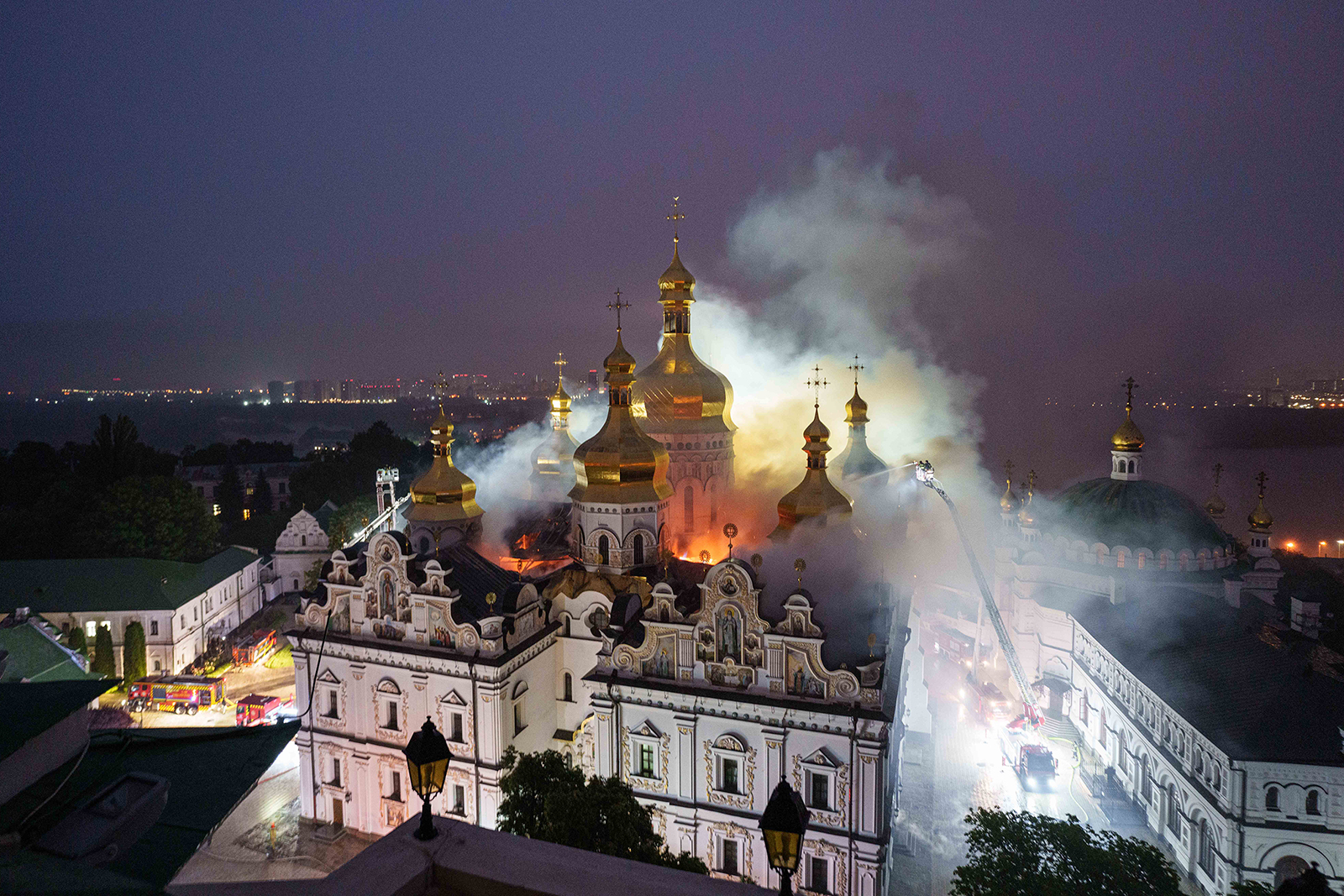
In mid-June, Russian drones struck an 11th-century church, Ukraine’s most important religious site. The church and its associated cave and monastery complex, called the Kyiv Perchesk-Lavra, is revered by Eastern Orthodox Christians globally and contains hundreds of icons and relics, including a crypt of saints from across the centuries.
The June 15 strike started fires in the Dormition Cathedral and damaged several other buildings on the grounds, which will take an estimated 10 million euros to restore, according to Ukrainian officials. The strike was among the most damaging to Ukraine’s cultural and religious heritage since the outbreak of the full-scale war in February 2022.
“Before this attack, we knew that they could target our culture, so we are already trying to preserve everything we can,” said Kateryna Shapovalova, the custodian of collections at the Museum of Kyiv History.
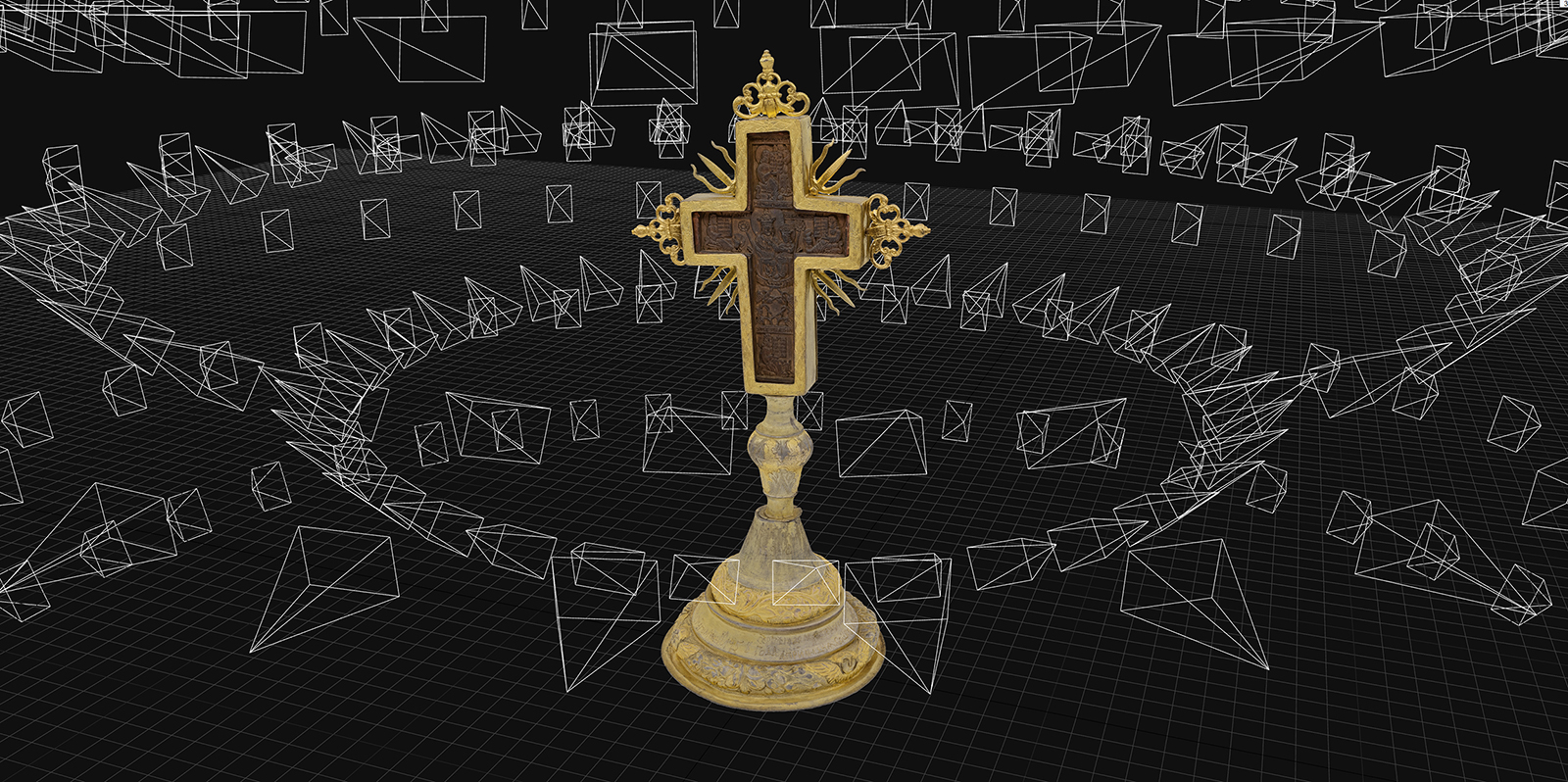
An Ark III 3D scan at Kyiv Pechersk-Lavra in Kyiv, Ukraine. (Photo © 2026 Paul Safko)
The Ark for Ukraine project, which Shapovalova is part of, has, since 2023, brought three mobile labs to Ukraine to help preserve Ukrainian cultural heritage by scanning archives of thousands of manuscripts, artifacts and even buildings to digitize them.
Shapovalova signed up to train with an ark unit after surviving a missile strike on her apartment complex that destroyed her own home.
“I want to save our culture and preserve what I can because I can see how it can stay in mine and everyone’s mentality when something precious can be destroyed,” she said, saying she felt so devastated after losing her apartment that she needed medication.
Arks I and II mobile units, established as a partnership between the national libraries of Ukraine and the Czech Republic, scan in 2D.
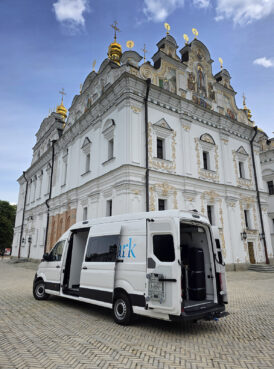
The Ark III mobile lab at Kyiv Pechersk-Lavra in Kyiv, Ukraine. (Photo © 2026 Paul Safko)
Ark III, a partnership between the Kyiv Perchesk-Lavra and the National Museum of the Czech Republic, takes on another dimension, equipped with drones to 3D scan everything from the smallest pieces of jewelry to entire cathedrals and monasteries.
“With all the technology we have on hand, we are able to create so-called digital twins to have perfect clones, digital clones, of all the real items,” Paul Safko, one of the architects behind ARK III, told Religion News Service.
The digital clones will never compare to seeing a real piece of history in front of your face, holding it in your hands, or in the case of Orthodox Christian worship, kissing an icon or asking a saint for intercession in the presence of their mummified body. But digital copies can be an essential tool for researchers around the world and for repairing and restoring damage.
The lab, built into the chassis of a Volkswagen Crafter van, was unveiled in front of Perchesk-Lavra in late May, less than a month before the complex was struck.
“We had to develop a unique solution, as, after I did some research, I found nothing like it existed before,” Safko said. “We decided to create a mobile station, a lab on wheels … the main idea was that if it’s in a dangerous zone, in case of an airstrike, alarm or any shooting nearby, the car is able to move, to run.”
The vans themselves have become targets, with their locations needing to be kept closely guarded, according to a spokesman for The Czech-based Karel Komarek Family Foundation, which funds the project.
The June 15 attack also struck Ukraine’s national film studio, destroying its entire historic costume collection, containing more than 100,000 outfits stretching back decades. A day earlier, a drone strike on the Kharkiv Museum of Art damaged over a thousand exhibits. And on June 16, a music hall in Dnipro and Kyiv’s National Chernobyl Museum were also damaged in attacks.
At the Museum of Kyiv History, precious underground space is saved for the most historically significant exhibits, while others are stored in aboveground safes, said Shapovalova.
The recent drone strike shattered glass throughout her museum, but that has become a normal occurrence, she explained, joking that she was thankful the history museum is in an old building rather than a modernist one with glass architecture.
According to UNESCO, some 536 registered cultural heritage sites have been verified as damaged or destroyed as of the beginning of June 2026. Of those, 154 are religious sites, like Perchesk-Lavra. A report by Ukrainian authorities estimated more than 1,700 damaged heritage sites.
In a country where 85% of the population identifies as Christian, and with longstanding Muslim and Jewish communities, those sites are a key part of Ukraine’s national identity, said Cyril Hovorun, a Ukrainian Orthodox theologian and scholar and associate dean at Sankt Ignatius Theological Academy in Sweden and senior lecturer at the Stockholm School of Theology.
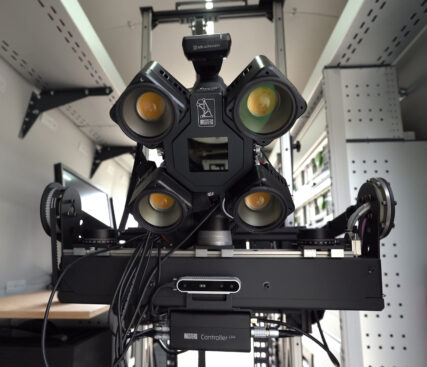
Ark III 3D equipment on May 25, 2026, in Kyiv, Ukraine. (Photo © 2026 Paul Safko)
Ukraine has remained on the border of Eastern and Western worlds for much of its history.
“Ukraine never wanted to be isolated; however, it always was on the fringes of different worlds, hence the name — which means borderland,” Hovorun said. “But it wasn’t just the borderland of Moscow, but of everything else in which Ukraine participated, of the Roman world, the Arabic world, the Slavic world, you name it.”
Ukraine’s Orthodox monasteries tell of its ties to the Eastern Roman world, its Catholic cathedrals to the Western one, its mosques to the Ottoman Empire and Islamic caliphates and its synagogues and Jewish cemeteries to the global Ashkenazi Jewish culture that spread from Ukraine to America, Israel and beyond, Hovorun said.
“That continues to this day. It’s reflected in our culture, our artifacts, archeological findings, literature and the mentality of the people,” he continued. “Largely this war of Russia against Ukraine has been a war against our identity. They want to destroy and obliterate our identity, and because those sites are part of our identity, they target them.”
Russia has not acknowledged intentionally targeting Ukrainian heritage sites and denied responsibility for the attack on Perchesk-Lavra, instead blaming American armaments for the damage.
But the denial of a Ukrainian culture and history distinct and separate from Russia’s has been one of Moscow’s justifications for the war since its start.
Russia has also been accused of systematically removing evidence of that culture from the regions of Ukraine it occupies, of “Russifying” Ukrainian children, and a year ago banning the Ukrainian language from being taught in schools in the occupied regions (areas that were largely Russophone before the war.)
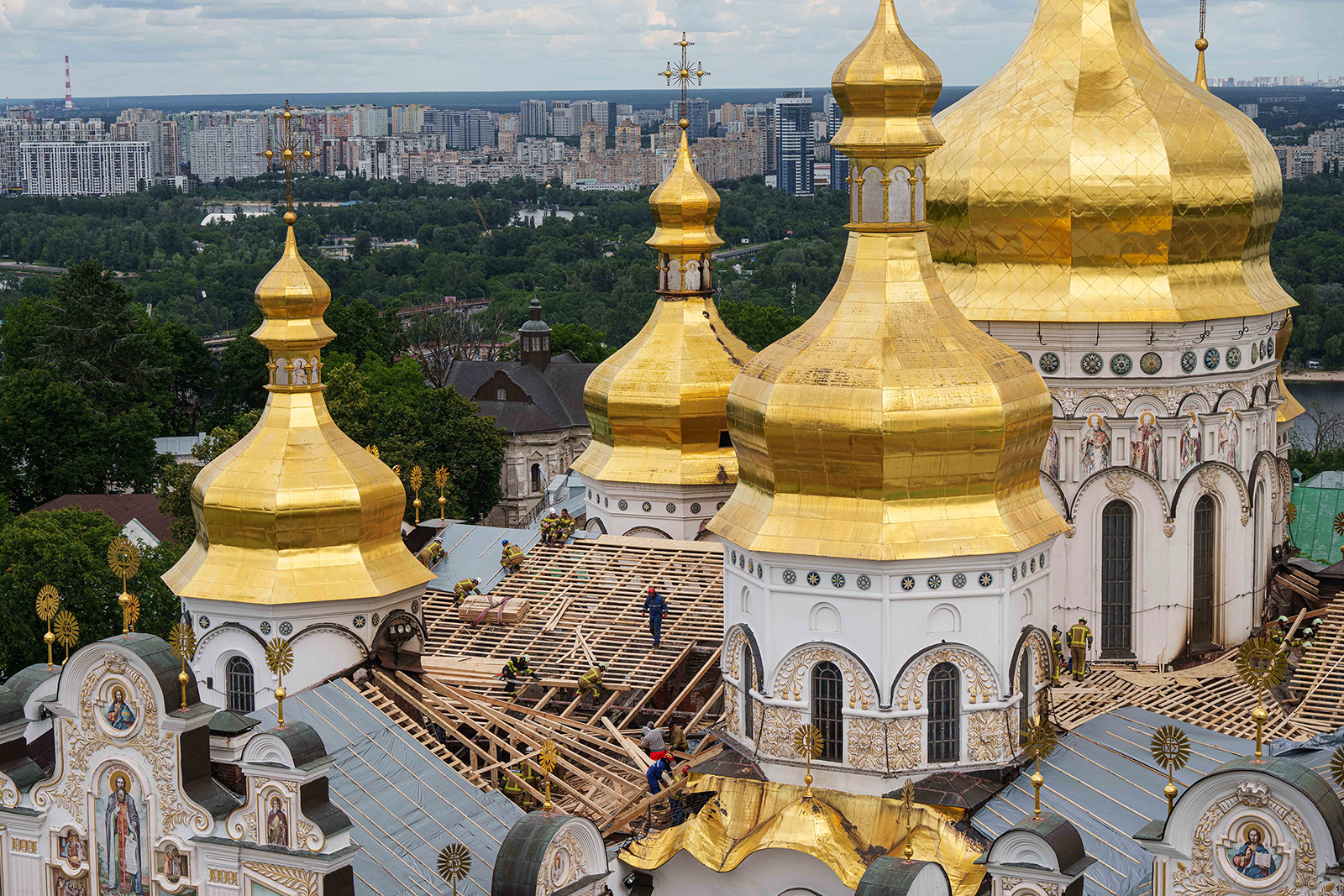
Rescue workers carry out temporary repairs of the roof of the Dormition Cathedral of thousand-year-old Monastery of Caves, also known as Kyiv Pechersk-Lavra, damaged after a Russian strike in Kyiv, Ukraine, Thursday, June 18, 2026. (AP Photo/Evgeniy Maloletka)
Lukáš Pfauser, spokesman for the Karel Komárek Family Foundation funding the Ark project with support from prominent Czech philanthropists, said that the organization was drawn to the project due to their country’s own experience as a satellite state in the Soviet bloc. Many accuse Russia’s leaders, who espouse a Russian World ideology, of trying to imitate the Soviet-era attempt at authoritarian unity.
“For 50 years we were under the totalitarian regime, so we have a huge experience from our own culture,” Pfauser said.
“The main quote in our minds was, ‘If a nation’s culture survives, then so too does the nation,’” he added, referencing the words of the famed Czechoslovak economist and art collector Jan Viktor Mládek.
Shapovalova wants everyone learning about Ukraine to know that Ukrainians are their own people, preserving their own culture that is hundreds of years old.
Ultimately, Shapovalova and her colleagues know they won’t be able to save everything.
“You always need to have priorities, and we’re always glad that we know we need to save our people first, and our items after that,” Shapovalova said.