'Yesteryear,' a tradwife satire, understands Christianity better than most Americans
(RNS) — The new bestseller has been criticized for having a shallow understanding of religion. I disagree. 'Yesteryear' depicts how shallow American religion has actually become.
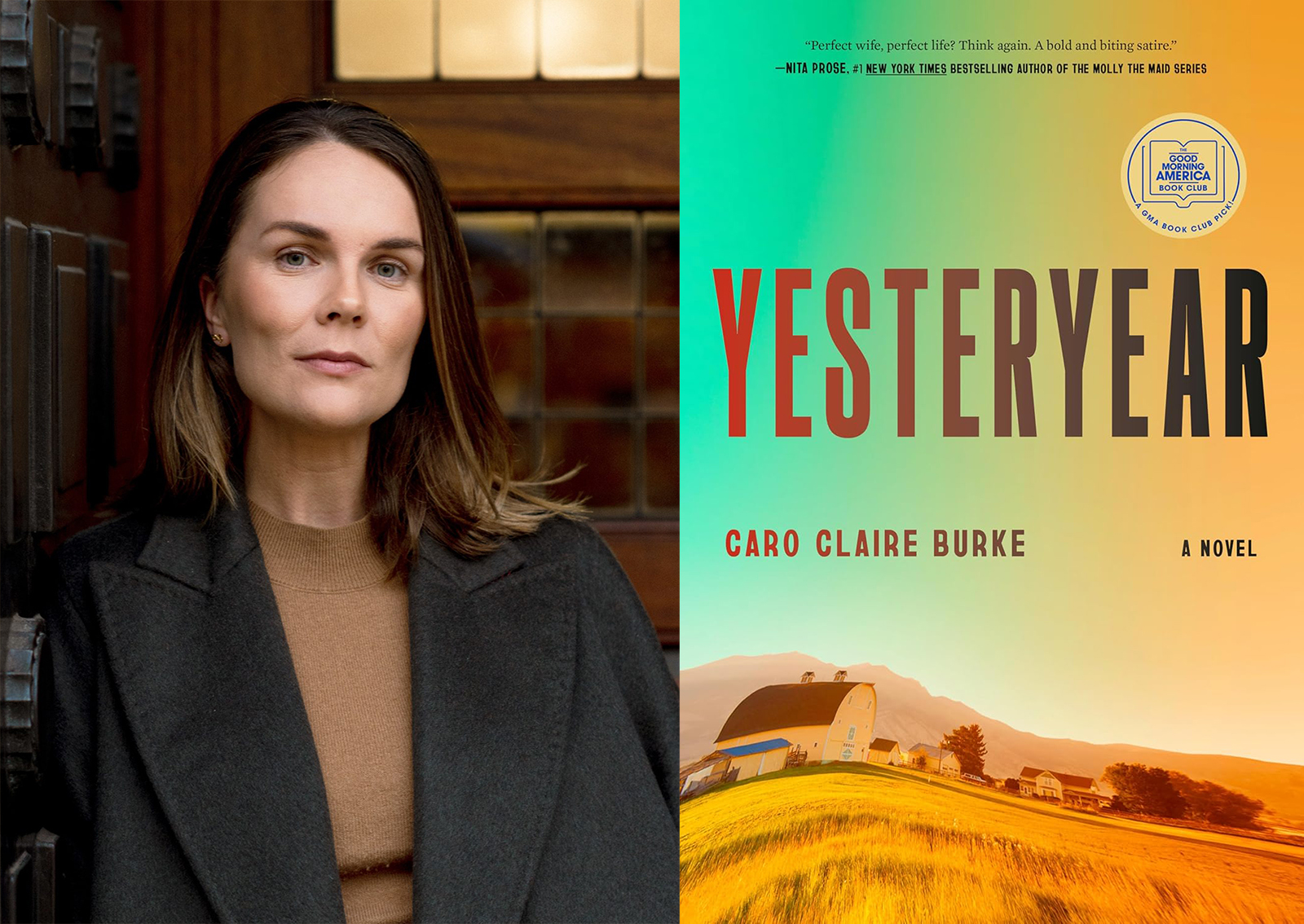
"Yesteryear" and author Caro Claire Burke. (Photo by Aistė Saulytė)
“Yesteryear,” one of the bestselling novels in America right now, combines caustic humor with cultural commentary to ruminate on religion and the tradwife movement. It’s a gripping read, which is particularly impressive since author Caro Claire Burke is a first-time novelist.
In what follows, I’m not going to give you any plot points that aren’t in the jacket copy or the opening pages of the novel. No spoilers here.
As the story opens, Natalie is on top of the world. Her rural Idaho farm, “Yesteryear,” is booming, and her family is about to grow from five children to six. The kids, clad in prairie garb in “a rainbow of neutrals,” help out on the farm, their efforts chronicled endlessly for Natalie’s millions of social media followers. Her husband, Caleb, the son of an ultra-wealthy U.S. Senator who has bankrolled their farm, has embraced the cowboy dream.
So far, the novel’s stage set sounds like a riff on Ballerina Farm, the famous Utah ranch where a former Juilliard-trained ballerina now lives with her husband, who is a son of Jet Blue’s billionaire founder, and their eight kids. (Wait, make that nine: We blinked and the Neelemans welcomed their ninth child a few months ago.) The family’s Mormon faith is a largely unspoken but persistent undercurrent of their social media empire.
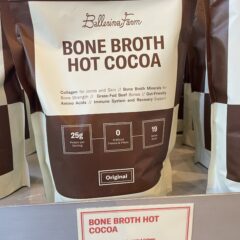
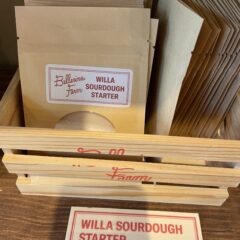
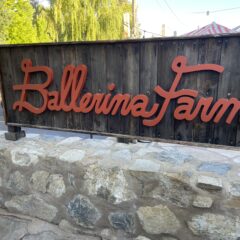
I started reading “Yesteryear” while I was in Utah a few weeks ago, visiting both the Ballerina Farm in Kamas and the store/café in Midway. It was hard not to see similarities between the Neelemans’ farm and the novel’s, including outrageous prices for their farm products. (Bone Broth Hot Cocoa mix: $46. A tiny pack of “Willa Sourdough Starter”: $18.)
(RNS photo/Jana Riess)
But if the novel begins with similar threads — a large religious family, bolstered by inherited wealth, becomes internet-famous — Natalie and Caleb’s lives take a darker turn.
What their Instagram followers don’t see is the army of low-paid laborers who keep both farm and family going. Fertilizers and pesticides are sprayed at night all over their “organic” fields of harvest. Natalie is distant from her children, who are being raised by nannies, and she despises Caleb.
Caleb is aimless; Natalie is nothing if not focused. So she focuses on fixing him, steering him away from his natural inclinations (nurturing children, having fun) toward an acceptably rugged form of Christian masculinity: farming. The central tragedy of the novel is how unsuited they both are to their assigned gender roles, and their utter inability to imagine a different, happier life. Natalie is a terrible wife and mother, but she’d be excellent at roles that are closed to her, like dictator of a small country. Caleb has zero leadership ability, but he’d be a stellar kindergarten teacher, a job considered beneath a righteous Christian man.
That’s where things stand when suddenly, the novel morphs into a horror story. Natalie wakes up in the year 1855, having apparently traveled back in time to Yesteryear farm. Unlike the nostalgically “authentic” farm she has curated for online consumption, this one is fully beaten down and ramshackle. Her 21st-century tradwife life, made possible by immigrant labor and high-tech machines, has devolved into a continuous round of washing mud-encrusted laundry until her knuckles bleed.
The people are different, too. Her 1855 husband, also named Caleb, is a hardened, abusive and weirdly capable version. Her children are not her real children though they keep calling her “Mama.” Natalie comes to believe she’s been cast in a hard-core frontier reality show. If she can play her role correctly until she figures out a way to escape, she may survive.
Religion is the backdrop threading through both timelines. Twenty-first-century Natalie thanks God for all His blessings (and it’s always “His” with a capital H) and apologizes to Him for her many curse-laden inner monologues, rendered in italics in the novel. 1855 Natalie, by contrast, prays for rescue and tries to view the unforgiving landscape as a test of her faith. All the while, she’s realizing that life for women under full-fledged patriarchy is far more terrifying than the version she has cosplayed online.
Various reviewers have commented that the characters don’t seem to truly embody one recognizable strand or denomination. This is evangelical Christianity, but a watered-down hodgepodge. It even has vestiges of Mormonism — for example, one evangelical character quotes Dieter Uchtdorf’s “doubt your doubts before you doubt your faith,” which Natalie recognizes as “an old Sunday School line.” There’s no defining characteristic to this brand of fundamentalist Christianity, other than conservative gender roles and MAGA politics.
This has led some readers to fault the author as not knowing much about religion, saying she doesn’t go deep enough into any one Christian tradition to make the story believable. I disagree. The novel accurately depicts how shallow American religion has actually become. From a sociology of religion standpoint, she has hit the nail exactly on the head. And that makes for an unflinching portrait.
In an interview with Lauren Jackson of The New York Times, the author says she grew up Catholic, but she made Natalie an unspecified fundamentalist Protestant. Natalie is attracted to the trappings of religion, but not wedded to theological belief per se:
. . . her relationship to her religion kind of moves in and out. She is not someone who is attached to the doctrine. She doesn’t understand scripture. Her relationship is very transactional.
I feel like I’ve spent the last decade watching people in power try on and then take off elements of religious strategy to see what works best.
Giving Natalie a specific denomination, Burke noted, would distract readers from seeing the commonality between religious fundamentalisms, like that they all limit women and are concerned about power. It would also “imply more of an intelligence than Natalie has about her own religion.”
Bingo. Natalie is a stand-in for millions of other Americans who like the idea of religion but don’t actually know much about it. They may own several Bibles and remember a few verses, but the “biblical Christianity” they’ve imbibed is about an inch deep.
Sociologists of religion and political scientists have been tracking this shift for decades. In the 1980s, Princeton University’s Robert Wuthnow wrote of the “restructuring of American religion,” in which Americans stopped caring about the theological differences between Christian denominations and started caring about the political ones.
What mattered a hundred years ago was where your church stood on issues like infant baptism or eternal punishment. What matters now is where your church stands on Donald Trump.
Politics leads religion now, not the other way around. Political identities have become oddly fixed, while religious ones are only sparsely grounded in actual religion.
This is a transformation that “Yesteryear” understands intuitively. Natalie and the family she marries into are defined not by Christian faith but by the politics of Christian nationalism. It’s only when she’s abruptly torn from that world that she begins to glimpse something deeper.
If the novel came with a black box warning, it would be: Be careful what you wish for, America. You just might get it.
As an independent nonprofit, RNS believes everyone should have access to coverage of religion that is fair, thoughtful and inclusive. That's why you will never hit a paywall on our site; you can read all the stories and columns you want, free of charge (and we hope you read a lot of them!)
But, of course, producing this journalism carries a high cost, to support the reporters, editors, columnists, and the behind-the-scenes staff that keep this site up and running. That's why we ask that if you can, you consider becoming one of our donors. Any amount helps, and because we're a nonprofit, all of it goes to support our mission: To produce thoughtful, factual coverage of religion that helps you better understand the world. Thank you for reading and supporting RNS.