


Learning what a trip to Jewish Poland has to teach


(RNS) — I spent much of the past month in Poland and Lithuania, learning about and visiting sites of the Jewish world that existed there until it was destroyed in the Holocaust. The occasion was an annual study tour sponsored by the YIVO Institute for Jewish Research, an institution established in Vilnius in 1925 — and relocated to New York City at the beginning of World War II — to study Eastern European language and culture.
The leader of the tour was my longtime Trinity College colleague Samuel Kassow. Born to Holocaust survivors in a displaced persons camp, learning Yiddish as his mother tongue and trained as a historian at Princeton, Sam is widely recognized as the world’s leading expert on Polish Jewry in the 20th century. He’s also a superb lecturer and storyteller.
His magnum opus, “Who Will Write Our History?” tells the story of the Warsaw ghetto archive compiled under the direction of Emanuel Ringelblum, a historian and community leader who was determined to ensure that real-time documentation of life in the ghetto not be lost and the story left for the Nazis to tell. Packed away and buried in metal boxes and milk cans before the ghetto’s destruction, the archive includes laundry lists and literature, religious reflections and reportage, children’s observations and scholars’ essays, political statements and “cris de coeur” (cries of the heart). The texts are primarily in Yiddish and Polish, with some in Hebrew and German.
While the archive has provided source material for a wealth of studies, there is nothing that approaches Sam’s account of its origins, how the work was done and who did it, and what it has to say about life in the ghetto from the time nearly half a million Jews were packed into it in 1940 until it was laid waste in 1943. What comes through is the vitality of a community under extreme pressure — a vitality that is something like the distilled essence of Jewish life in Poland in the 20th century.
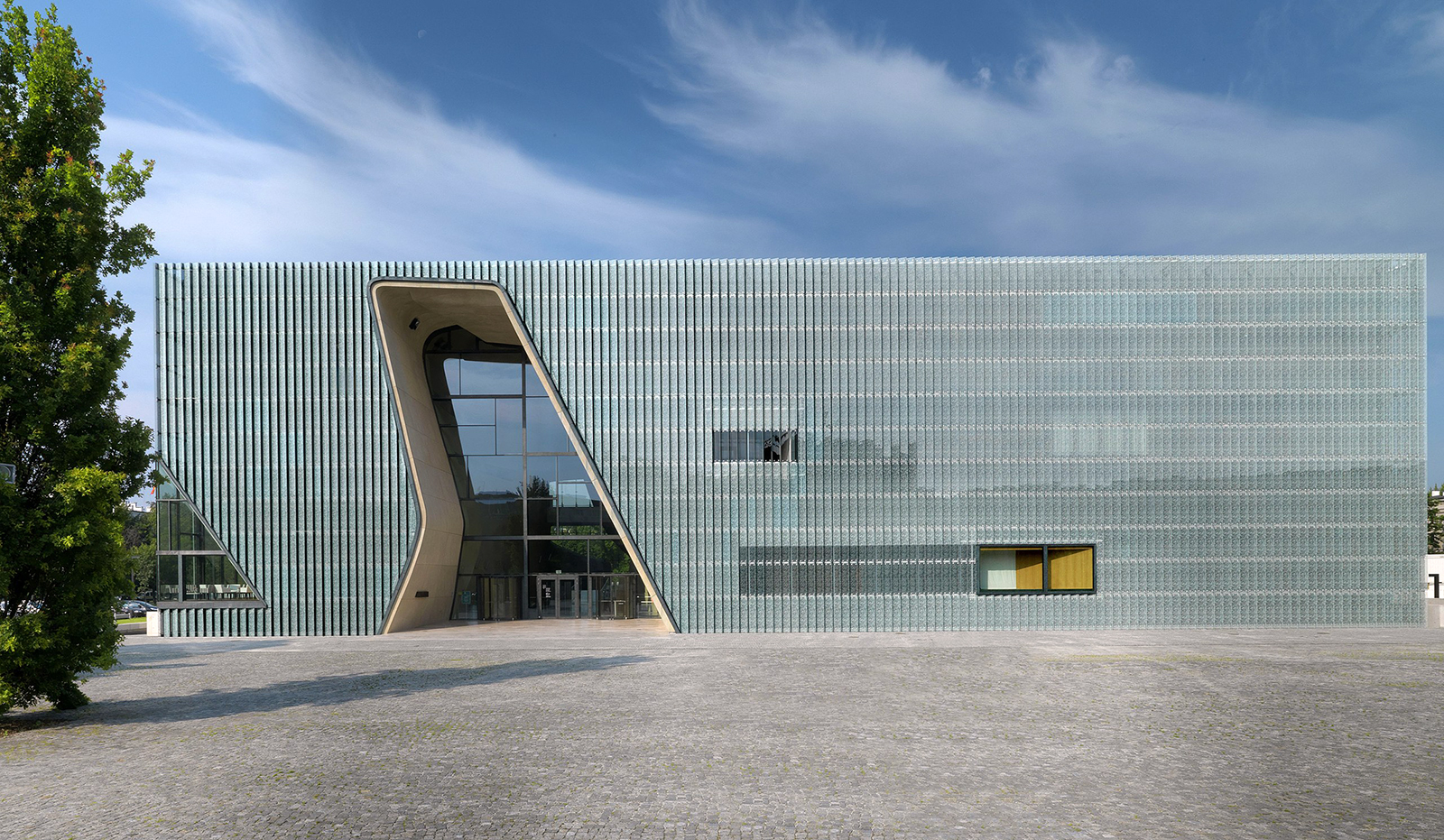
The larger story is conveyed by the POLIN Museum of the History of Polish Jews, which opened in Warsaw in 2013 and for which Sam designed the exhibits devoted to the 20th century.
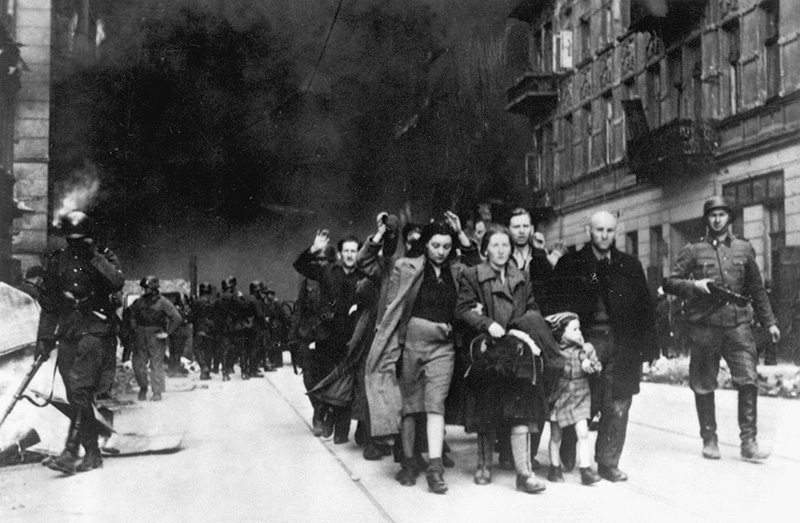
Jewish civilians are led by German Nazi troops to the assembly point for deportation during the Warsaw Ghetto Uprising in April 1943. Housing blocks burn in the background. (Photo courtesy of NARA/Creative Commons)
While the museum does not stint on its portrayal of the Holocaust, it wisely does not present the history of Polish Jewry as one long anticipation of it. Jews were brought to Polish lands by powerful nobles who needed managers and merchants capable of organizing the sale of lumber and grain to the countries of Western Europe in the early modern era. In the 19th century, Jews were drawn en masse to the fast-growing cities, where they often constituted a plurality if not a majority of the population.
The result was a fully articulated Jewish society. There were the religious, including Hasidim and anti-Hasidim, cheek by jowl with a large segment of the population that had fallen away from observance. There were Jewish workers and Jewish criminals, Jewish manufacturers and traders, Jewish doctors and lawyers, Jewish artists, composers, playwrights, novelists and poets. Jewish newspapers in Yiddish and Polish were published in profusion. In the arts, modernism thrived.
All this took place amid a complex and fraught politics. In the wake of World War I, when the European empires of Russia and Austria-Hungary were disassembled, Jews constituted one of the minority “nations” inhabiting every new nation-state of Eastern and Central Europe and the Baltics.
Zionism was the form of Jewish nationalism that cultivated Hebrew and considered emigration to Palestine the answer to “the Jewish question,” but there were others. The socialist Bund opposed emigration in favor of organizing workers in the here and now. Other Jewish organizations, secular and religious, sought government support for Jewish institutional life. And there were those who simply wanted to be Poles “of the Mosaic faith.” The internal politics of the interwar Jewish community in Poland make today’s Jewish politics look like the Peaceable Kingdom.
Of course, it was impossible not to reckon with the Final Solution.
We visited the Ponary Forest outside of Vilnius where Lithuanian volunteers under the direction of Nazi death squads (“Einsatzgruppen”) murdered 75,000 Jews (along with 2,000 Poles and 8,000 Soviet POWs) and threw their bodies into ditches — an enterprise that began right after the Germans captured the city in June 1941 and which marks the beginning of the Holocaust. We also visited Treblinka and Auschwitz, where extermination was turned into an industrial process.
The other people on the tour were almost all liberal North American Jews, at once highly critical of the Israeli government and deeply distressed at the rise of antisemitism in the West and the world’s readiness to consider Israel as little more than an illegitimate, genocidal state.
It is one thing to conclude that the Israeli military has committed war crimes in Gaza or that the Netanyahu regime supports ethnic cleansing on the West Bank. It is quite another to consider the Israeli response to Oct. 7 that has resulted in the deaths of less than 5 percent of the population of Gaza as equivalent to the Nazis’ unprovoked murder of over 90 percent of Polish and Lithuanian Jewry.
The difference has to do not just with scale but with motivation and policy. However genocide is defined, that would seem to be obvious.
Less obvious, but of greater significance at least for us Jews, is the fact that Israel is the closest equivalent to the Jewish world that existed for just a few decades in Poland. It is a fully articulated Jewish society with its own language, its range of religious and non-religious, its cultural vitality, its contentious politics.
But unlike Polish Jewry, Israeli Jewry has agency, for better or worse. Recently, it’s been for worse. I pray for better.