


Before we moved to Malawi, my husband and I celebrated our tenth anniversary a little early by going to see Philip Seymour Hoffman as Willy Loman in Death of a Salesman in New York.
I’d long loved Hoffman’s film performances — particularly in Doubt, Capote, and The Savages — and regularly channeled his perfect, nasally-whiney Truman Capote (with whom I share a birthday as well as what one Times writer called his “elfin stature”) to express my writerly anxiety or confidence, depending on the day.
Death of a Salesman always does me in, even reading the script — all the longing, desperation and futility of life distilled down into commonplace gripes about a broken refrigerator — buying things on credit only to have them break just as you’re done paying for them, paying off a house just as the kids are growing up and leaving.
Willy Loman’s self-delusion, his awkwardness and his bravado is nothing short of heartbreaking, and though Hoffman was just 44 when I saw him onstage, he inhabited the role with the gravitas of a much older man. It was magnificently sad and beautiful to watch. Now it sort of feels like I was watching Hoffman’s life — not just Willy Loman’s — draw to a tragic end.
But the clip that keeps running through my mind when I think of PSH is this one from Doubt, in which Hoffman portrays Father Flynn, who’s accused of inappropriate conduct with an altar boy on very slender evidence. We, the audience, are left in a state of doubt, never knowing for certain whether or not Flynn is innocent. I love it because Hoffman is convincing as a New York priest, because of how his character tells the story in different voices and accents, and I love it because it’s a great piece of preaching and a well-told story:
In differing ways, each of these roles captures an essential aspect of the sense of exile so many of us feel. Who among us has never wearied of the working, the getting, and spending? Who among us has never gotten lost in reveries of a past that we remember as so much more bearable than the present? And who among us has never felt the bitter aftertaste of gossip — or unmooring, creeping doubt? It is not a coincidence that his most compelling roles confront us with some of the most difficult human emotions and experiences.
May your eternal rest be peaceful, Mr. Hoffman. May your family be comforted and held by grace.
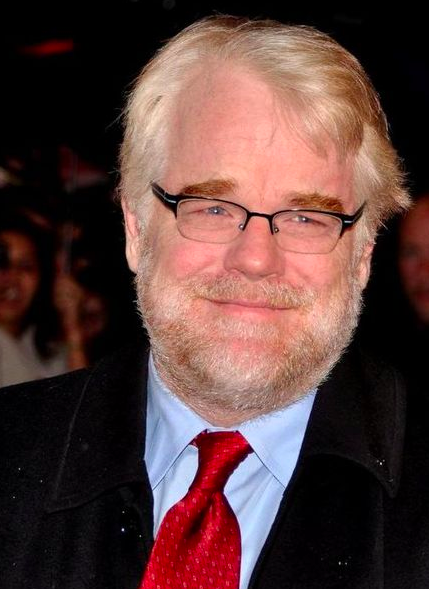
Philip Seymour Hoffman at the Paris premiere of The Ides of March, October 2011. Photo courtesy Georges Biard via Wikimedia Commons.
