At a sprawling shrine to Shiva, Nepal's Hindus help the dead on their way
KATHMANDU, Nepal (RNS) — Located on the banks of the Bagmati River in the Himalayan country's capital, the Pashupatinath Temple complex is the site of daily ritual cremations.
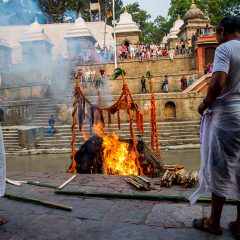
A group of men move to ignite the funeral pyre of a relative at the Pashupatinath temple in Kathmandu, Nepal. Cremations are held every day at the famous Hindu temple. RNS photo by Jair Cabrera Torres
KATHMANDU, Nepal (RNS) — The Pashupatinath Temple complex in Nepal is one of the world’s most important sites dedicated to the Hindu god Shiva, comprising more than 500 temples, shrines, ashrams and monuments. Located on the banks of the Bagmati River in the Himalayan country’s capital, Kathmandu, the temple is also the seat of Nepal’s national deity, Lord Pashupatinath. It is here that many Nepalis bring their dead for Hindu cremation rituals.
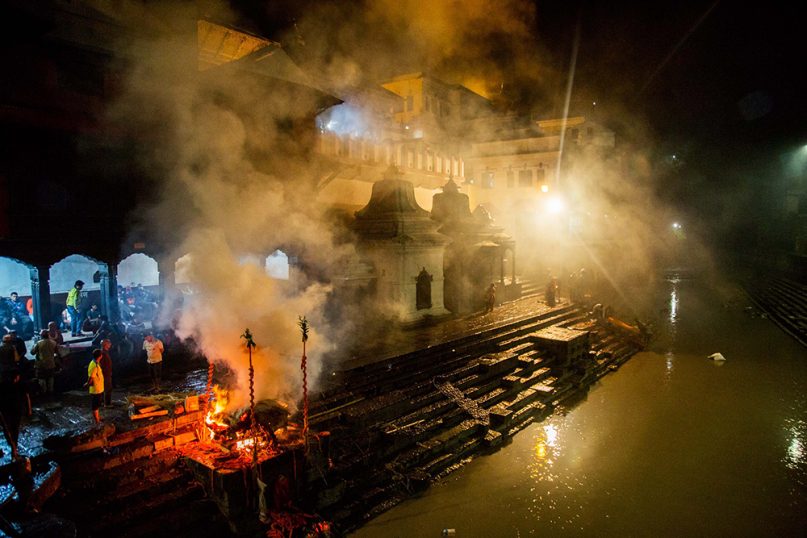
Located on the banks of the Bagmati River in Kathmandu, Nepal, the Pashupatinath temple complex hosts many Hindu funeral rites and cremations each day. RNS photo by Jair Cabrera Torres
Hindus understand that death is a part of life and an important step on the soul’s journey.

When a person dies, relatives ritually wash the wrapped body in the river’s waters before cremating it on wooden pyres built on one of several platforms along the river.
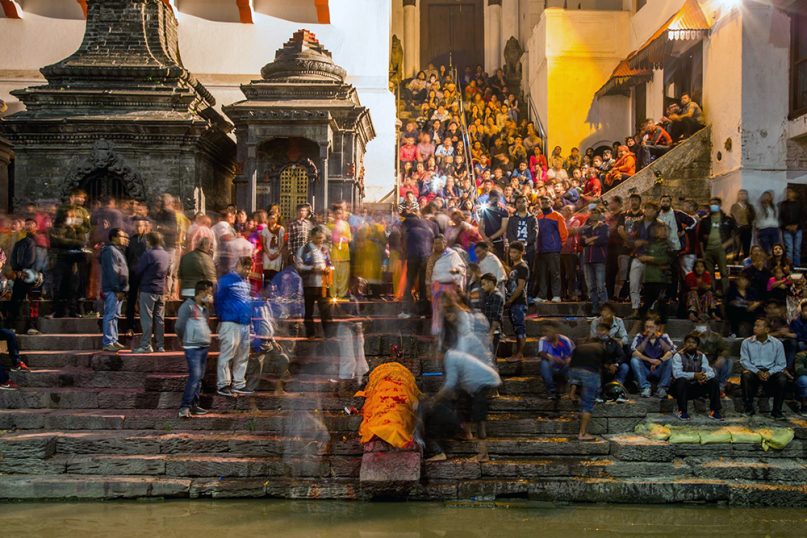
Hundreds of Hindu devotees and tourists visit the Pashupatinath temple in Kathmandu, Nepal, every day. Cremation ceremonies are held in full view of all visitors. RNS photo by Jair Cabrera Torres
Hindus believe that cremation severs ties to our earthly life and allows a soul to continue on its spirital journey. The funeral pyre is traditionally ignited by the deceased person’s eldest son, but a daughter or nephew may perform the ritual in a son’s absence. RNS photo by Jair Cabrera Torres
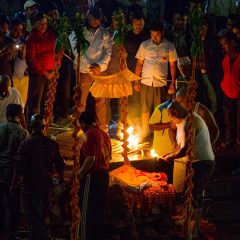
Public cremations at the Pashupatinath temple normally last about four hours. The ashes of the cremated remains are then pushed into the Bagmati River. RNS photo by Jair Cabrera Torres
Relatives say their final farewells to the deceased in public funerary rites at the Pashupatinath temple. RNS photo by Jair Cabrera Torres
Hindus are expected to cremate a deceased person’s body within 24 hours of death. The ritual cremation is believed to help sever the person from their earthly experience and expedite the soul’s spiritual journey. Hindus believe that a human must return to the five elements, and cremation is faster for that process than burial.
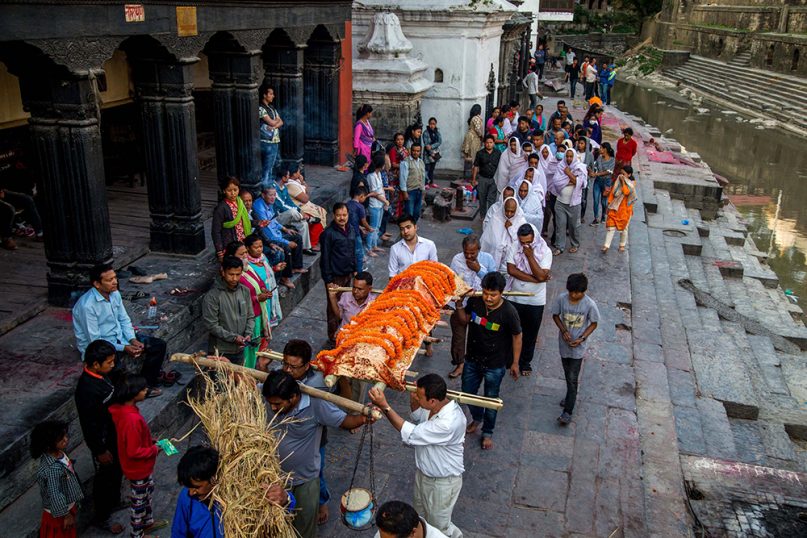
A family procession accompanies their relative’s body to its cremation at Kathmandu’s Pashupatinath Temple complex. RNS photo by Jair Cabrera Torres
An aerial view of Kathmandu, the capital of Nepal. RNS photo by Jair Cabrera Torres
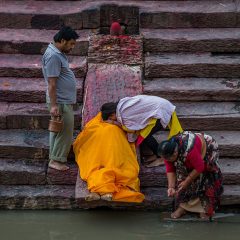
Relatives wash the feet of their deceased loved one with holy water from the Bagmati River at the Pashupatinath temple complex in Kathmandu, Nepal. After ritual washing, the body is carried to a nearby platform for cremation. RNS photo by Jair Cabrera Torres
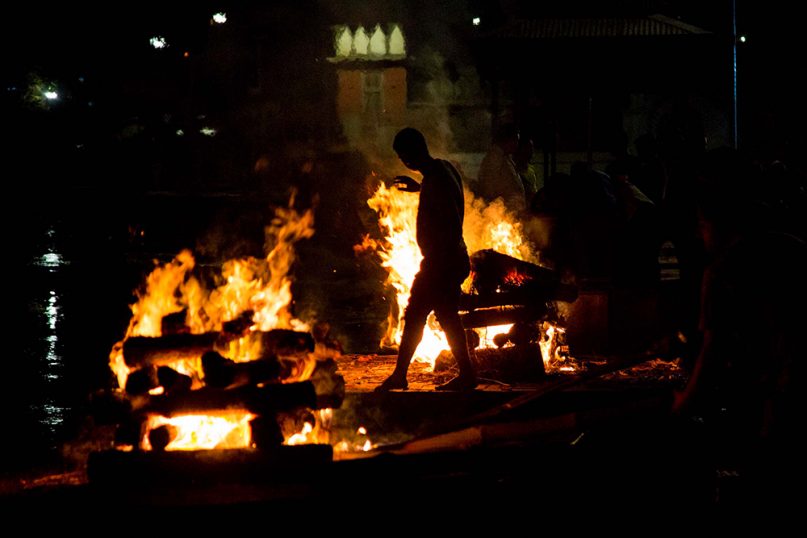
Cremations at Pashupatinath temple complex continue day and night in Kathmandu, Nepal. Hindus are expected to cremate their dead within 24 hours of death. RNS photo by Jair Cabrera Torres
Once the cremation is complete, and everything has been reduced to ashes, the remains are put in the Bagmati River to be returned to nature.
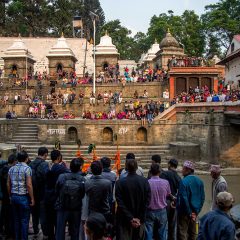
Cremations often take place simultaneously at Pashupatinath temple along the Bagmati River in Kathmandu, Nepal. RNS photo by Jair Cabrera Torres
A cremation takes place, left, while another group, right, bathes the feet of a deceased loved one in the Bagmati River at the Pashupatinath temple complex. RNS photo by Jair Cabrera Torres
Link copied!
No paywalls here. Thanks to you.
As an independent nonprofit, RNS believes everyone should have access to coverage of religion that is fair, thoughtful and inclusive. That's why you will never hit a paywall on our site; you can read all the stories and columns you want, free of charge (and we hope you read a lot of them!)
But, of course, producing this journalism carries a high cost, to support the reporters, editors, columnists, and the behind-the-scenes staff that keep this site up and running. That's why we ask that if you can, you consider becoming one of our donors. Any amount helps, and because we're a nonprofit, all of it goes to support our mission: To produce thoughtful, factual coverage of religion that helps you better understand the world. Thank you for reading and supporting RNS.