


135 cardinals will elect the next pope. Francis picked 108 of them.


(RNS) — As more than a billion Catholics mourn the death of Pope Francis, cardinals around the world are preparing to travel to Rome to begin the solemn tradition of choosing a new pontiff.
And when the prelates gather at the Vatican in the coming weeks to elect a new Bishop of Rome, Francis, who died at age 88 on April 21, stands to have an outsize impact on the vote.
That’s because, unlike some of his predecessors, Francis has appointed the overwhelming majority of clerics who can cast a ballot in the conclave — namely, members of the College of Cardinals who are under age 80. He crossed a crucial threshold in September 2023, when he finally appointed enough voting-eligible cardinals over the course of his papacy to constitute more than two-thirds of voting members in a conclave, the margin required to elect a pope under the current rules.
And according to an analysis by Religion News Service, as of April 21, of the 135 members of the College of Cardinals eligible to vote, 108 — 80% — were appointed by Francis. An additional 16.3% were appointed by Pope Benedict, and only 3.7% were tapped by Pope John Paul II.
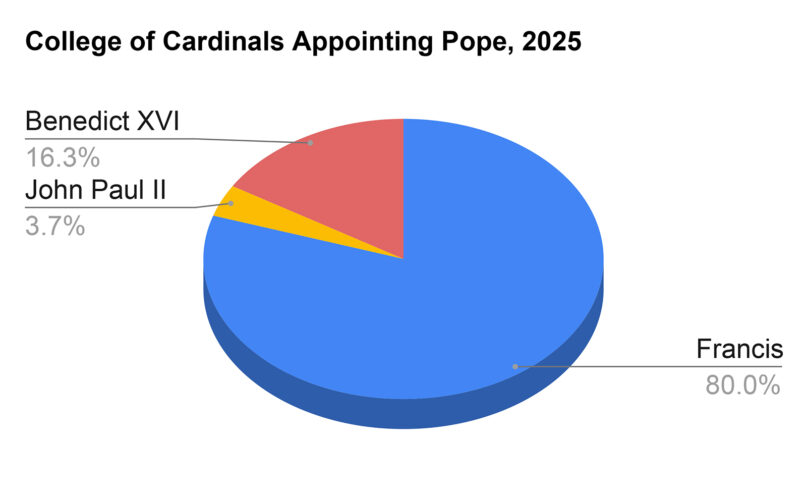
“College of Cardinals Appointing Pope, 2025” (RNS graphic)
By comparison, when Francis was elected pope in 2013, 57.9% had been appointed by his recently retired processor, Pope Benedict. An additional 42.1% were appointed by Pope John Paul II.
The current electorate is also more geographically diverse than in years past. In 2013, for instance, Italian cardinals alone made up nearly a quarter of voting members at the conclave, but they only constitute 12.6% of those eligible in the coming conclave. Meanwhile, prelates hailing from Asia expanded from 8.8% in 2013 to 17% today, and representatives from Africa have also increased their numbers from 8.8% to 13.3%.
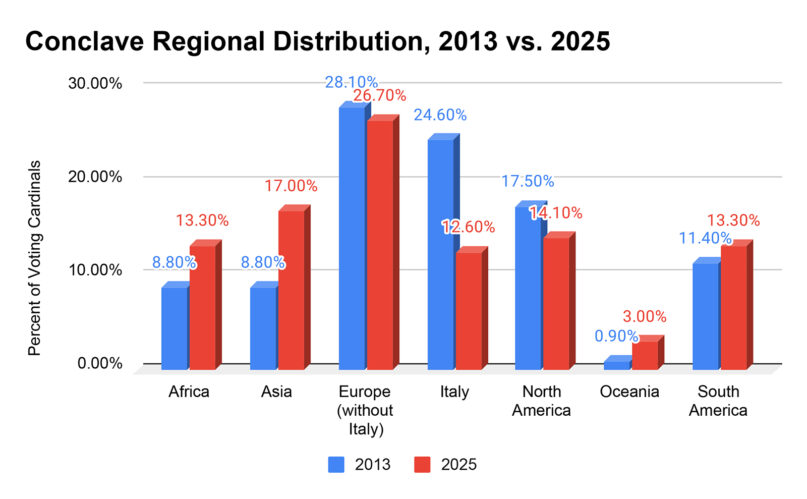
“Conclave Regional Distribution, 2013 vs. 2025” Sources: Publicly available Vatican data, Wikipedia, independent RNS reporting. (RNS graphic)
Outside of Italy, Europe has roughly maintained its influence, representing around 28% of the conclave in 2013, compared to around 26.7% today. North America has lost ground, dropping in representation from 17.5% to 14.1%, while South American prelates have slightly increased their numbers under Francis, the first Argentinian pope, rising from 11.4% to 13.3%.
How these changes will impact the vote remains to be seen. Francis’ 12-year papacy was marked by a focus on the poor, immigrants and the effects of climate change, and he has tended to select like-minded cardinals. But cardinals aren’t the same as members of Congress with specific party loyalties, and voting outcomes can sometimes be difficult to predict.
It’s also possible some of the numbers could shift in small ways before voting begins, as past conclaves have seen some surprise last-minute changes. Even so, whoever becomes the next pope will be chosen by a group largely hand-selected by Pope Francis himself.
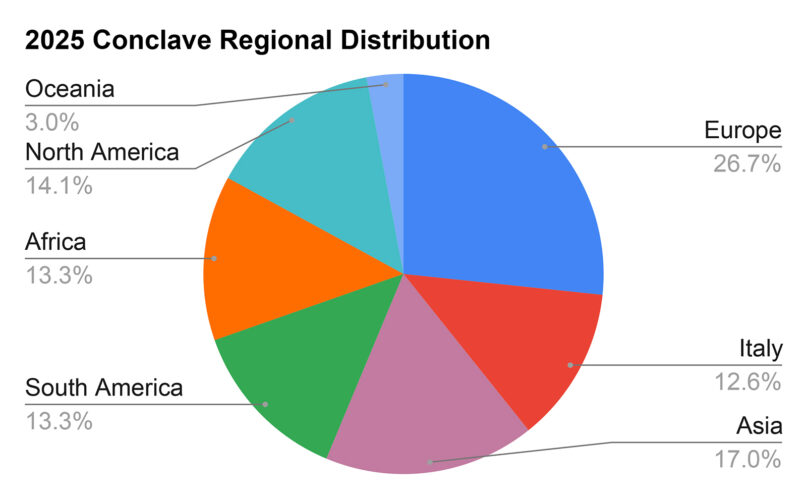
“2025 Conclave Regional Distribution” (RNS graphic)
This piece has been updated.