


Israel's LGBTQ+ activists push back on 'pinkwashing' claim
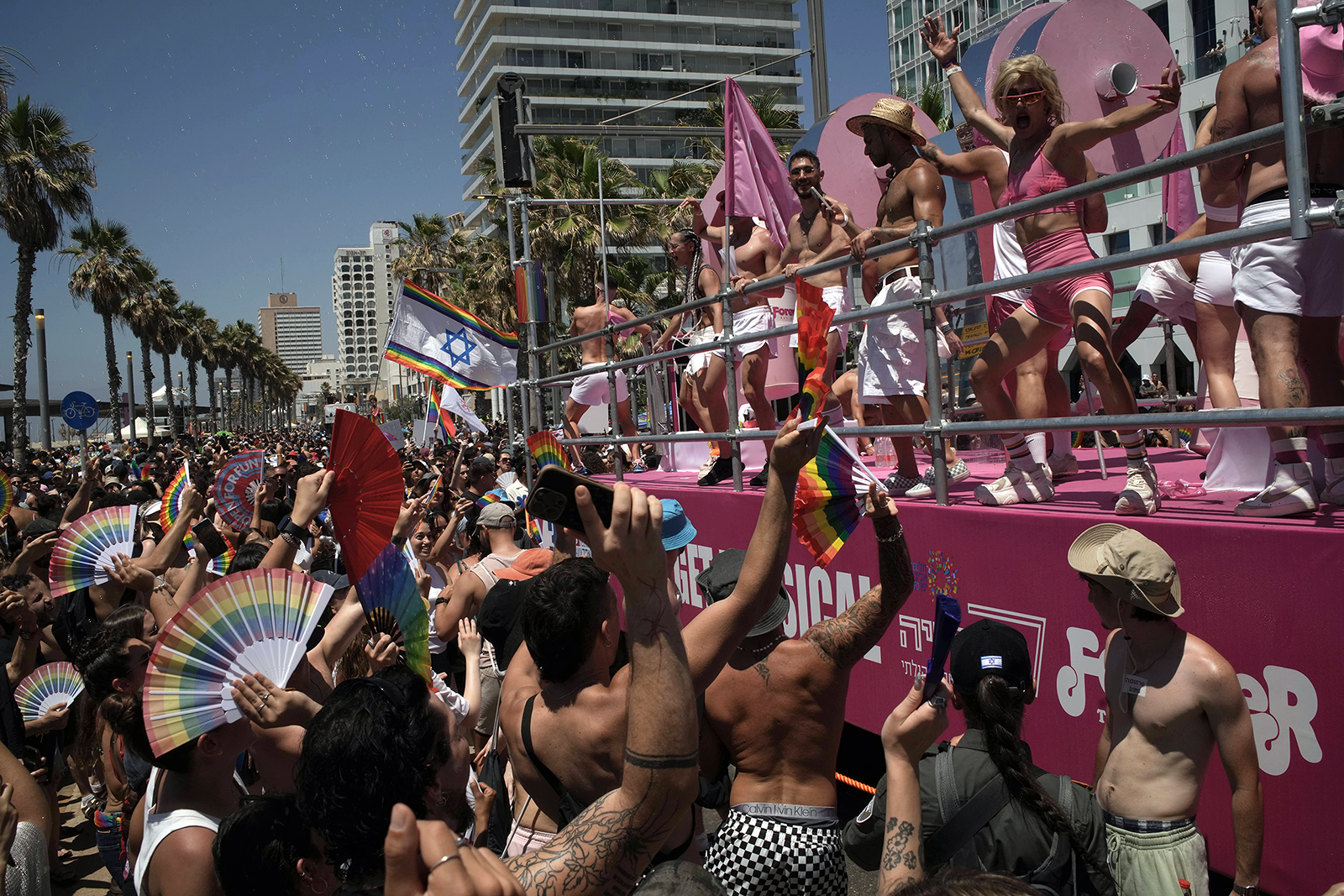


(RNS) — When Avi Sofer, now 77, was a young, closeted gay man, sexual relations with someone of the same sex were illegal in Israel. Today, because of the activism of Sofer and many other LGBTQ+ Israelis, Israel is the most LGBTQ-friendly country in the Middle East. It offers most of the legal protections found in progressive Western countries.
Though the community is still fighting for equality on some fronts, “we’ve made tremendous, tremendous progress,” Sofer told RNS. “Today, we can serve openly in the army, there is an LGBTQ center for Arabic-speakers in Haifa, and the healthcare HMOs provide care to LGBTQ patients.”
Despite these and other achievements, many pro-Palestinian activists accuse the Israeli government and even LGBTQ+ individuals in Israel of “pinkwashing.”
According to the anti-Israel BDS Movement, pinkwashing “is an Israeli government propaganda strategy that exploits LGBTQIA+ rights” to deflect attention from its treatment of Palestinians.
If anyone is engaged in deflection, the Anti-Defamation League says, it is anti-Israel activists who “refuse to recognize any positive Israeli attributes and willfully ignore the realities of the country’s vibrant democracy to justify and promote their rhetorical attacks against Israel.”
In some countries, LGBTQ+ activists have banned their Israeli and even local Jewish counterparts from joining their organizations or Pride events, claiming that all Israelis and diaspora Jews are “complicit in genocide.” Meanwhile, Israeli LGBTQ+ activists are among their government’s staunchest critics.
“I don’t understand this pinkwashing accusation,” Sofer said. “I’m the first one to talk about Israel’s problems. You want me to hide my identity and pride to make you feel better?” he said, addressing his anti-Israel peers.
Since the October 7, 2023, Hamas massacre and the ensuing war in Gaza, when Sofer has been invited abroad to speak about LGBTQ+ life in Israel, the organizers “don’t want me to say the good stuff. Only the bad stuff,” he said. “They want me to present a certain view, but I refuse to lie.”
Sofer attributed these negative expectations to bigotry. “They hate Jews, they hate Israelis, and they hate our LGBTQ community. Instead of painting us as a part of a bridge, they say we’re the problem.”
Yael Sinai Biblash, CEO of the Agudah, Israel’s leading LGBTQ+ rights organization, said that most of the community’s achievements — from the right to adopt a child or to have a child via a surrogate mother to recognizing both partners as their child’s parents — have resulted from rulings by the High Court.
Still, there is no civil marriage in Israel, and the official Jewish and non-Jewish religious authorities there do not perform marriages of interfaith or LGBTQ+ couples. Such marriages aren’t illegal, but they are not recognized by the Interior Ministry unless the couple has a civil marriage abroad.
“This doesn’t affect only the LGBTQ community,” Biblash emphasized. “No one can register as married without the rabbinate” or other religious authority.
As a result, many heterosexual and same-sex couples marry abroad so their unions can be recognized in Israel.
Parental rights also remain an issue. According to Biblash, “for both LGBTQ spouses to be named as their child’s parents, they need to petition the court. It doesn’t happen automatically, as it does for heterosexual parents,” she said. “We’re working to change this.”
Activists blame the far-right government of Prime Minister Benjamin Netanyahu for withdrawing funding from programs that serve the LGBTQ+ community.
“Since this government came to power, we’ve had severe budget cuts for help lines and healthcare,” Biblash said. “This is a very conservative, right-wing government. It hasn’t advanced any LGBTQ laws or rights and has cut 40% from our services budget.”
Finally, Biblash wants the Israeli government to grant permanent asylum to LGBTQ+ Palestinians who have fled the Palestinian-ruled parts of the West Bank because homosexuality there is illegal and their lives are in danger. As it stands, the Israeli government provides them with temporary residency permits but not asylum.
M., a young Palestinian who sought refuge in Israel, said he feared for his life while living in the West Bank.
“If my uncles or neighbors had known I was gay, they would have killed me,” M., who requested anonymity, said. “Here in Tel Aviv, I live an openly gay lifestyle. It’s a huge relief to be able to be myself, but without permanent residency I can’t put down roots here.”
Linor Abergel, the Israeli founder and chairwoman of Trans Israel, said she leads a good and open life as a transgender woman in Tel Aviv.
“The LGBTQ community in Israel has a lot of laws that support them,” Abergel said. “To be a gay guy or trans woman in Israel isn’t shameful.”
Whatever challenges trans people face, they “aren’t institutional,” she said. Just as there are places in the U.S. where trans people are made to feel unwelcome, such places exist in Israel as well.
Abergel said Israel has undergone sweeping social change during her lifetime. She is especially grateful that the country’s universal healthcare system now fully funds gender transition surgeries and that LGBTQ+ people can live openly while working in governmental positions.
At one time, she said, openly gay or trans people usually found jobs as hairdressers or in the arts. “Now we see them working in the Knesset, the court system, the police and the army.”
Sofer said his life reflects the evolution of LGBTQ+ visibility in Israel. “I was a married man, the father of two children, and I came out in my 30s,” he recalled. “At the time, there was very little LGBTQ activism.”
He became an activist when a rabbi said he should not be left alone with his children because he was gay.
“I knew I was fighting for my children, who were 12 and 9 at the time,” Sofer said. “I found myself on the front lines and never left.”
Discrimination on the grounds of sexual orientation was prohibited in 1992, and the next year, the IDF permitted soldiers of every sexual orientation to serve.
“This was the first foot in the door,” Sofer said. “The key to Israeli society. Then there was an avalanche” of progress that continues to this day, even in religious communities. During the past decade or so, increasing numbers of religious LGBTQ+ Israelis have come out and stayed religious while remaining in their communities, he noted.
As in most other countries, older Israeli LGBTQ+ couples still find it challenging to find an old-age facility where they can live together as spouses. But the overall situation is vastly improved, Sofer said.
Biblash rejected claims that Israel’s LGBTQ+ community functions as a public-relations tool for the Israeli government.
“The Pride parade isn’t the government,” she said. “People who do a parade in Jerusalem or Tel Aviv are LGBTQ people expressing their rights.”
She said international boycotts and criticism are harming the very people working to advance liberal causes inside Israel.
“Israel is here to stay; we are Arabs and Jews and LGBTQ,” Biblash said. “You would think these people would support the liberal voices in Israel, changing the reality here. They are doing the opposite.”