


The Latina women in Texas reshaping the UMC


(RNS) — The Rev. Rosedanny Ortiz, a Puerto Rican pastor now based in Texas, felt alone and uncertain about her future in ministry after her United Methodist church closed due to COVID-19 complications and she suffered a stint of mental health crises.
“I had so many mixed feelings, and all this personal struggle,” she said.
Yet her commission this summer within the United Methodist Church — a public affirmation of an individual’s divine calling to ministry — represented a turning point.
“This commission was extremely special for me because it was God reassuring me that this was what I was called for,” she said. “All my experience, I can channel it into that ministry.”
She now serves as lead pastor of Agape Memorial in Dallas, a step up from her former associate pastor role and a pathway to ordination in 2028.
Ortiz is one of a handful of Latina United Methodist Church leaders in Texas who are emerging with fresh models for ministry by meeting the demands of Texas’ changing demographic landscape following years of schism, decline and uncertainty within the denomination.

The Rev. Rosedanny Ortiz, left, sings during a worship service. (Photo courtesy of Ortiz)
For many, their leadership is vital to the survival and flourishing of United Methodist congregations across the state and throughout the nation amid heightened anti-Hispanic sentiment and growing Spanish-speaking populations.
“How can we celebrate the diversity of humanity that God created in the first place?” Ortiz asked in an interview. “How, as a church, can we embrace it, and how, as a church, can we lean into it so we can educate our community, so we can show, even more, who God is in our midst?”
“I feel like her story is mine”
In the last few years, the United Methodist Church — the largest mainline Protestant denomination in the United States — has experienced massive restructuring.
While some denominations have split over the ordination of women, the Methodist movement has ordained women since the late 19th century.
Instead, since 2020, the denomination has shed roughly 1 out of every 4 congregations after delegates at the general conference voted to lift a ban on same-sex weddings and LGBTQ+ clergy.
In 2020, there were 6.3 million United Methodists in the United States. Now, estimates are slightly below 5 million — a 21% decline in just half a decade.
Disaffiliating churches have been predominantly white, and a dramatic 71% of disaffiliations have occurred in the U.S. South. In Texas, well over 400 churches disaffiliated, and the Northwest Texas Conference of the United Methodist Church lost 81% of its churches.
In a state with over 32 million residents, Hispanics are the largest ethnic group in Texas and comprise 40% of the population. Though they make up only a fraction of national UMC membership, Pamela Hughes, the director of communications for the UMC’s Horizon Texas Conference, is certain that “in Texas, Latinos represent not only the church now, but also the church of the future.”
Leading institutions that cultivate Hispanic and Latino UMC clergy and laypeople agree.
After receiving a grant from the Lilly Endowment, Southern Methodist University’s Perkins School of Theology in Dallas launched the Centro de Acompañamiento, Solidaridad y Adiestramiento in 2024, which offers laypersons in Dallas, Houston and Plano ministry certificate programs in Spanish to train Hispanic leaders “at a time when they are needed perhaps more than ever.” 12 students have completed the program and 15 are on track to finish this fall.
“CASA courses provide an opportunity to think and reflect on responses to injustice and anti-immigrant laws, and develop local action plans to respond to the immediate and long-term needs of those who have been impacted by these recent changes,” a representative of the school said over email.
Perkins has prioritized theological education for Latino leaders since the 1970s with “the creation of the Mexican American Program and the publication of ‘Apuntes,’” the representative added.
“The training of Hispanic leaders ought to be one of the highest priorities of any seminary that seeks to prepare leaders for the present and the future — especially for seminaries in the Southwest,” said Bryan P. Stone, Leighton K. Farrell Endowed Dean of Perkins School of Theology.
Groups like El Plan have been working to help the UMC develop a comprehensive “Hispanic/Latine” ministry for over three decades.
El Plan Executive Director the Rev. Lydia Muñoz said that the denomination has historically attempted to import monolithic ministry models from Latin American countries that do not tend to the particulars of being “Latine” in the United States.
Latina leaders are at the forefront of helping the denomination address persistent gaps in its approach to ministry, including the failure to recognize the “bicultural, multi-ethnic realities” that young adults and families face, Muñoz said in an interview.
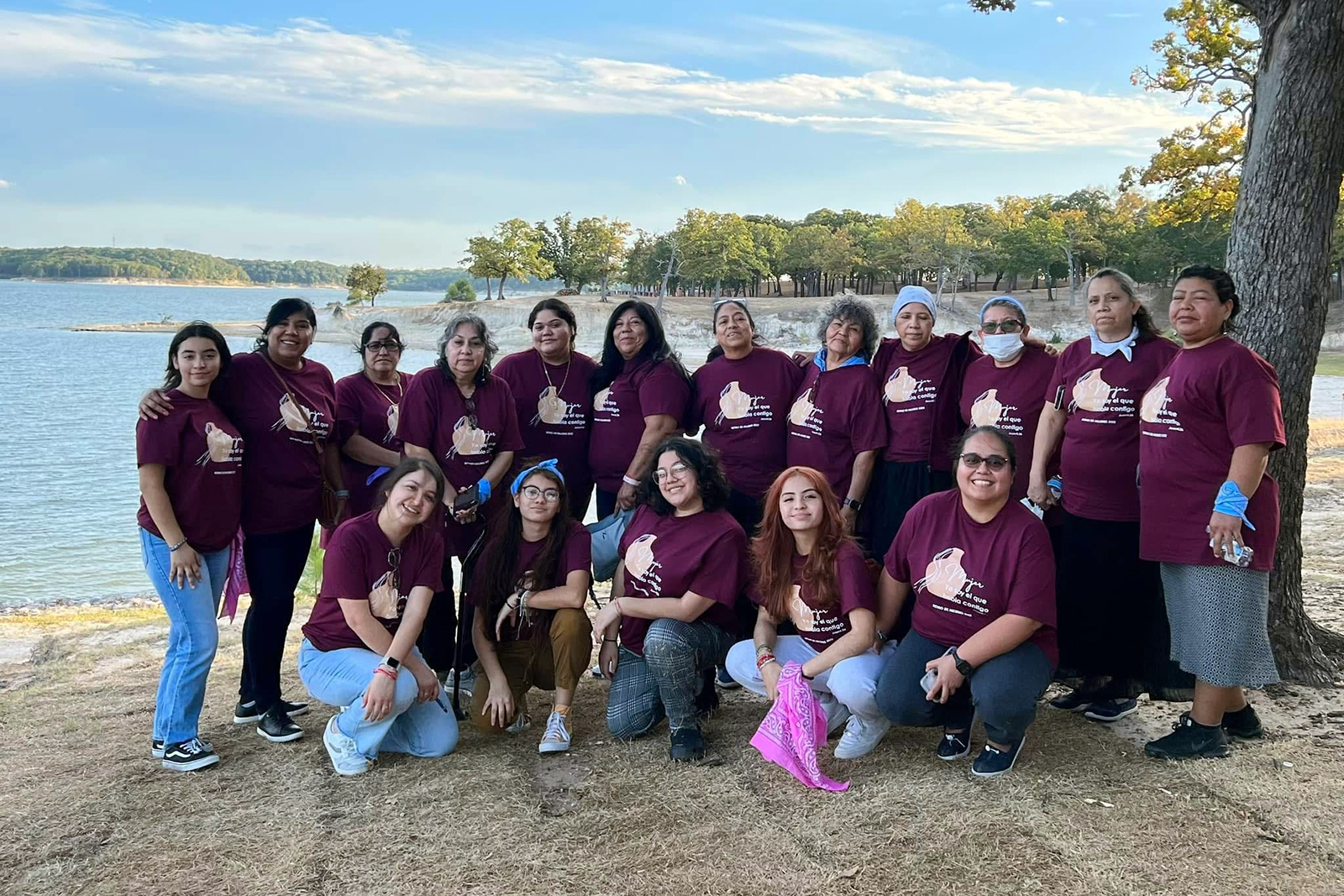
The Rev. Martha Valencia, bottom right, with other attendees during an annual Horizon Texas Conference Latino Women’s Retreat. (Photo courtesy of Valencia)
The Rev. Martha Valencia, who has been a pastor at Elmwood-El Buen Samaritano UMC outside of Dallas for nine years, said that growing up on “the hyphen” of being Mexican-American has been integral to her ministry.
“It was a challenge for me,” she said. “I, at times, didn’t feel Mexican enough for the Mexicans … and I didn’t feel American enough for the Americans.”
“But the thing that challenged me most when I was growing up … has now become my superpower,” she said. “Being on the ‘hyphen’ has provided me with skills and a voice and cultural intelligence that I didn’t see then, but I see now and can use specifically to empower other women in my circles.”
Pastor Isabel Márquez, who currently serves at Oak Lawn United Methodist in Dallas, said her life and ministry “has been surrounded by working with migrants.”
One of her ministry goals is to build “safe passage for people that are navigating the immigration systems here” and walk alongside individuals as they wade through that uncertainty, she said in an interview.
Márquez draws inspiration from the biblical story of Esther.
“She’s a migrant, she’s with family, she’s in these lands that are not hers, and she’s afraid,” Márquez said. “But also, she was encouraged by the people who saw her gifts.”
“I feel like her story is mine,” she added.
“The daughters of Eve have been shaped to cause change”
Serving as a role model for other women is especially powerful for Latina leaders who come from communities where women cannot be ordained or hold leadership positions. Hispanic Catholics are now the single largest religious bloc in Texas, at about 20% of those with a religious affiliation, and within the tradition, women cannot become ordained priests. Meanwhile, Protestant denominations have expanded their Spanish-language outreach, and the share of U.S. Latinos identifying as Protestant has risen in recent years.
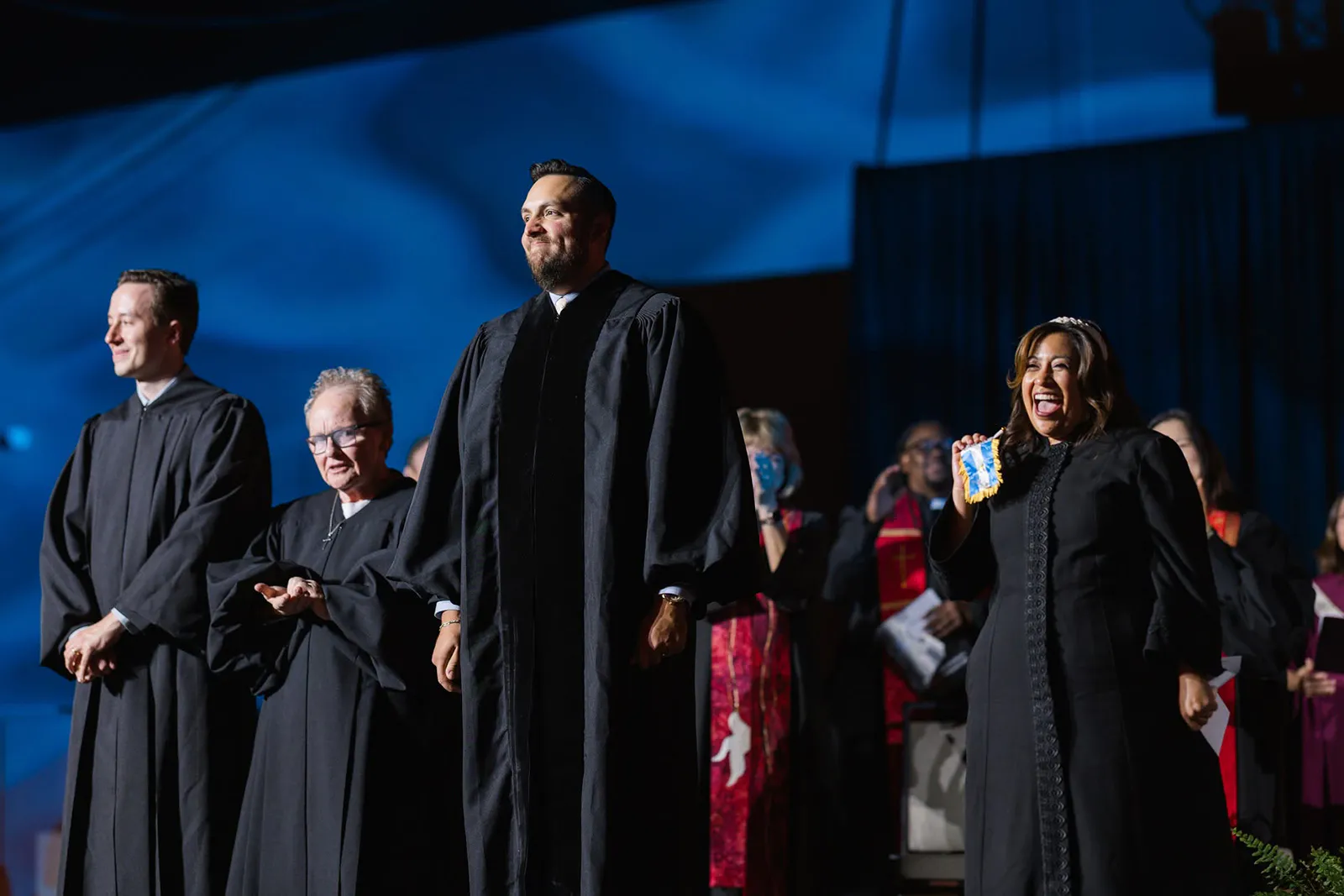
The Rev. Julia Puac-Romero, right, smiles during the Ordination and Commissioning Service at the Horizon Texas Annual Conference, Tuesday, June 2, 2026, in Wichita Falls, Texas. (Photo courtesy of the Horizon Texas Conference of the UMC)
It was difficult for the Rev. Julia Puac-Romero, a campus minister at the Wesley Foundation, to tell her Catholic family about her role in the United Methodist ministry. “Women don’t lead in the Catholic Church at this level,” she said.
“At first they were not comfortable with it,” she said, but after she sent videos of the bishop commissioning her in Spanish, they responded with praise and affirmation.
“So it’s been beautiful, in that sense, but as a Latina in this ministry world, sometimes it is still very hard to make that space happen,” she said.
Valencia, the pastor at Elmwood-El Buen Samaritano, grew up Pentecostal, which she said is a denomination that does not always encourage female leadership.
“I thankfully grew up in a church that did support women in the pulpit, but I know that’s not the case for everyone,” she said.
“When I came into the United Methodist Church, being a woman and being Hispanic/Latino, I didn’t know what challenges I would face, and ultimately, I discovered that people were very supportive — both men and women — of my call to ministry,” she said.
Women make up over 30% of United Methodist clergy. Muñoz of El Plan said that women who achieve leadership positions often remark that they once didn’t know it was possible.
In the United Methodist Church, women have not only been present but instrumental figures, comprising the majority of remaining leadership in the years following schism and disaffiliation, Muñoz said. A large proportion of disaffiliated UMC churches were led by male pastors.
“It goes in part with history, right?” she said. “These women have always carried communities, and have always carried the church… The daughters of Eve have been shaped to cause change.”
Though the UMC tradition has provided pathways for women that the Catholic church has not, Muñoz said that there is a different “clarity of the Pope, particularly around issues of justice, around immigrants … that has resonated with a lot of Latinos and Latino young people.”
The United Methodist Church, on the other hand, has historically released “nebulous statements about what’s happening in the world,” Muñoz added.
Today’s Latina United Methodist leaders are not shying away from the variety of issues impacting their congregations, especially immigration.
Puac-Romero, the campus minister, leans into “mujerista theology,” a form of liberation theology that is “based on the reflections of immigrant Latinas,” she said. For her, talking about the “grace of Christ” means you have to also talk about justice and immigration rights.
When her students asked for help with an on-campus information table about immigration, Puac-Romero turned to faith.
“It is possible to both have the same kind of justice that Jesus had when he’s flipping tables,” she said, referring to a story in the New Testament often cited as a righteous form of protest, “and also be able to do it in a loving and compassionate way.”

The Rev. Rosedanny Ortiz speaks to an elementary school class about her job in ministry. (Photo courtesy of Ortiz)
Ortiz, the lead pastor at Agape Memorial, tries “to preach hope in the midst of all the turmoil that we live in right now, especially toward the Hispanic community,” she said.
“We are suffering, we are dying,” she said. “We came to the United States because we wanted something better, and then they’re taking us back to that place where we flew in the first place.”
Still, Ortiz says the gospel is one of hope. “The bad things are still, unfortunately, happening, and sometimes are out of our control, but still, God listens to us,” she said.
The emerging Latina leaders also recognize that Christian theology and Scripture have also grounded defenses to the obstacles they continue to face. Several Protestant pastors and clergy have been at the forefront of support for ICE raids. Yet for figures like Valencia, ministry leaders are called to “help people (let) their guard down, reauthor myths, reauthor prejudices.”
“We are all part of the body of Christ,” Valencia said. “The foundation is love, love of God and love of neighbor … everything else comes down to that,” she said.