

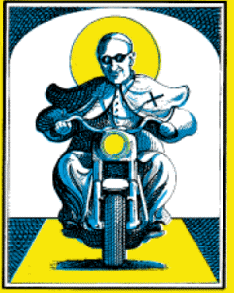


Print by Stephen Alcorn
For a quarter-century, more American Catholics felt their church was out of touch with their needs than the other way around. Just before the election of Pope Francis two-and-a-half years ago, the margin was 53 percent (out of touch) to 39 percent (in touch).
Since then, according to a new New York Times/ CBS poll,the numbers have reversed: 53 percent now think the church is in touch with their needs as compared to 40 percent who think it’s out of touch. There’s been an even stronger reversal about whether things are getting better or worse in the church (or stayed the same), from 17 percent (better)-22 percent (worse)-60 percent (same) to 36 percent (better)-12 percent (worse)-49 percent (same).
The evidence of a Francis effect is detectable in other ways. Two-and-a-half years ago, just 19 percent thought Pope Benedict and the Vatican had done a good job of handling the clergy abuse crisis, while 69 percent thought they’d done a poor job. Now, 48 percent think Pope Francis and the Vatican have done a good job; 40 percent, a poor job. In toto, 53 percent of American Catholics strongly approve of the direction Francis is leading the church, with an additional 26 percent approving somewhat.
An overwhelmingly majority approve of his support for the poor, and by large majorities approve of the job he’s doing addressing the environment, immigration, and the global distribution of wealth. They’re similarly supportive on issues specifically related to the church. Eighty-seven percent approve of his recent decision to speed up the annulment process. On the neuralgic issue of whether to Catholics who have divorced and remarried without an annulment should be allowed to take Communion, 63 percent say they should.
In line with previous surveys, two-thirds of American Catholics said they think that priests should be allowed to marry and that women should be allowed to be priests. Three-quarters approve of artificial birth control.
There’s been a certain amount of chatter about conservative opposition to the pope, and it is not hard to identify Catholic clerics and lay people (including some prominent intellectuals) who are unhappy with what Francis is doing. But conservative Catholics as a whole don’t feel that way. Forty-eight percent of them strongly approve of the direction he’s taking the church and 26 percent somewhat approve. (Ten percent somewhat disapprove and four percent strongly disapprove.) This, despite the fact that they are evenly divided on the question of whether he has the same priorities they do.
Nor is it the case that it’s the lukewarm and lapsed who really like this pope. To the contrary, 66 percent of weekly Mass attenders strongly approve of Francis’ direction, as compared with 47 percent of those who attend less frequently.
In total, 30 percent of American Catholics say they think the church has changed “a lot” during Francis’ short tenure as pope and 46 percent say it’s changed “somewhat.” I’d say that, as His Holiness prepares to roll into the U.S. for the first time, they’re up for a good deal more of what he has to offer.