

My conversation with a Palestinian-American


(RNS) — I am spending a weekend with some old and dear friends. We are all Jewish, and affirmatively so; all of us veterans of the Reform youth movement; some of us leaders and retired professionals in the movement now.
We are sitting in the hotel lobby when a young woman, a hotel manager, approaches us with a tray of craft IPA beers and offers them to us.
We thank her for her graciousness, and we invite her to join us for a conversation. We discuss music and sports, and she gives us her business card.
One of my friends reads her name and says: “You have a very interesting last name. Where is it from?”
Her last name is Arabic. In fact, it is a very common Arabic surname.
She tells us she is a Palestinian-American. She tells us her father was born in 1972 in Kuwait, “after the Zionists expelled his parents from Palestine in 1967. Then, they came here, and I grew up in Michigan.”
Awkward silence.
It was neither the time nor the place to challenge her history and her geography; there was no Palestine at that time. This, however, was clear: her grandparents had left the West Bank after the 1967 Six Day War, and they migrated to Kuwait, which had become a haven for well-educated, increasingly tech-savvy Palestinians. They had emigrated from there to Michigan, which is the home of a substantial Arab and Palestinian population.
Taking a sip of my beer, I looked her in the eye, smiled and said: “I am a Zionist.”
Without missing a beat, she said: “I don’t really pay much attention to that stuff. What’s happening now is horrible for everyone.”
“My father is the one who really pays attention. He gets so upset about everything. He told us that he is boycotting (name of prominent company) because they have said they stand with Israel.”
Again, looking her in the eye: “So do I. I stand with Israel. We all do — every one of us here. He, and he, and he” — I say, pointing at each one of my companions — “we all stand with Israel.”
Awkward silence.
“Really?”
“Yes. There is something else that I want to tell you.”
“We all feel empathy for your people. We care about the dignity of Palestinians. In better and saner times, each of us would have supported, and might still support, a two-state solution. Because, we are two peoples who love the same land.”
She was silent.
“Let me show you something,” I said.
I reached for my phone and opened my photographs, and I said: “These are photographs that I took on a recent trip to Israel. These are photographs that I took in east Jerusalem. In Al-Quds (“the holy place,” the Arabic designation for Jerusalem”).
I took her on a photographic tour.
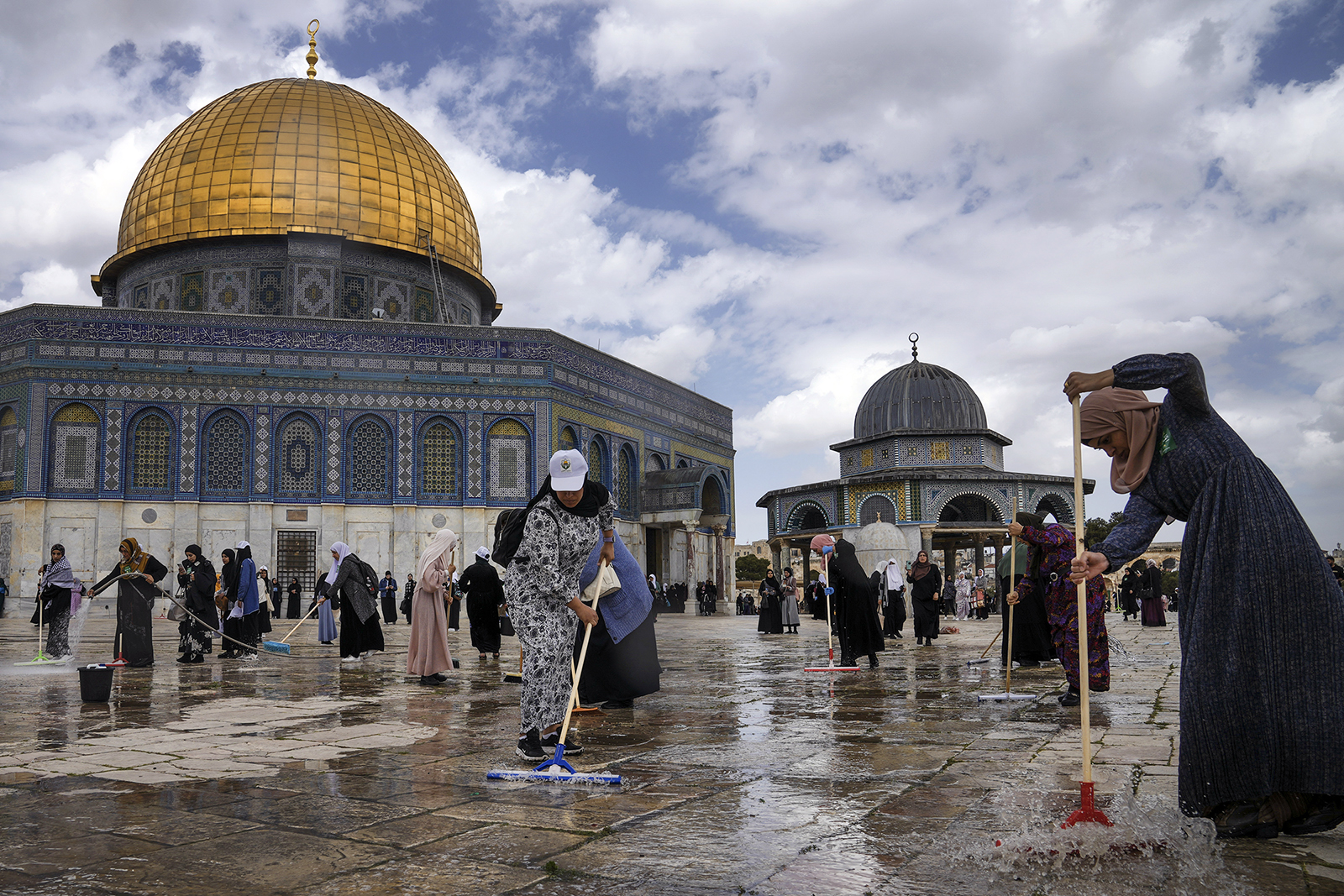
“It is very difficult to get permission to go up to the Temple Mount in east Jerusalem. But, a few summers ago, I went there with a group. Here is a photograph of the Dome of the Rock and the interior of Al-Aqsa. These are important and sacred places. This is your legacy.”
“Wow,” she said. “This is amazing. You go to Israel?”
“Every July. I study (at the Shalom Hartman Institute) in Jerusalem. I study sacred texts, and we discuss ways to create a shared society — between Jews, the Arabs who live in the state of Israel and Palestinians.”
“This is amazing,” she said. “How can I go? Are there trips I can go on that will take me to Israel and Palestine?”
“Funny that you should ask. We just happen to have an old and good friend who might be able to put something like that together.”
And then, it was good night.
I tell this story because I have been thinking of the holiday of Hanukkah, which just ended.
The haftarah (prophetic reading) for the Shabbat of Hanukkah is from Zechariah 4. It ends with: “Not by might, and not by power, but by My spirit — says the LORD of hosts.”
The ancient sages knew what they were doing when they assigned this prophetic reading to the holiday of Hanukkah. Frankly, they weren’t all that crazy about the Maccabees; neither were they entirely gung-ho about war.
By giving this passage “prime time” in the synagogue, they were emphasizing that the life of the spirit is quite often more important than weapons, battles and war.
That is what I was trying to do. I was putting aside the sword of rhetoric and trying to respond to the divine spirit within me, and within another person.
Because there we were — two human beings — an American Jew and an American Palestinian. Both of us rooted in our stories. Both of us caring passionately about our people, and both of us, carrying within us, the traumas of the recent past and of our history.
Did I “bend” further than I might have expected? Was I deliberately playing the typical role of the Jewish liberal? Was I pandering, referring to Jerusalem by its Arabic name, Al-Quds, “the holy city,” which is a designation that we share?
No. I was not bending, but stretching — stretching to hear her story; stretching to use her language; stretching to make that human connection; stretching to demonstrate a kind of emotional generosity and even hospitality — a hospitality that is the trademark of both of our desert cultures.
Because (pun alert) peace comes piece by piece, when we see the Other for who they are, and become real to that person, but mostly become real to ourselves.
When we are fully present, as my ancestors were for each other and for God, by saying “hineini,” here I am.
When writing about the Holocaust, Judith Miller had said the deaths occurred “one by one by one.”
So it has been now, in this current conflict. We have heard the stories of the hostages, and we have felt each death with pangs of ancient pain — one by one by one.
But, there’s something else that happens one by one by one.
Conversation. Soulful encounter.
And, yes: peace.
If not between entire peoples, then perhaps between two persons.
Inshallah. May it be God’s will.