


Romanians flock to a new cathedral that is the world’s largest Orthodox church
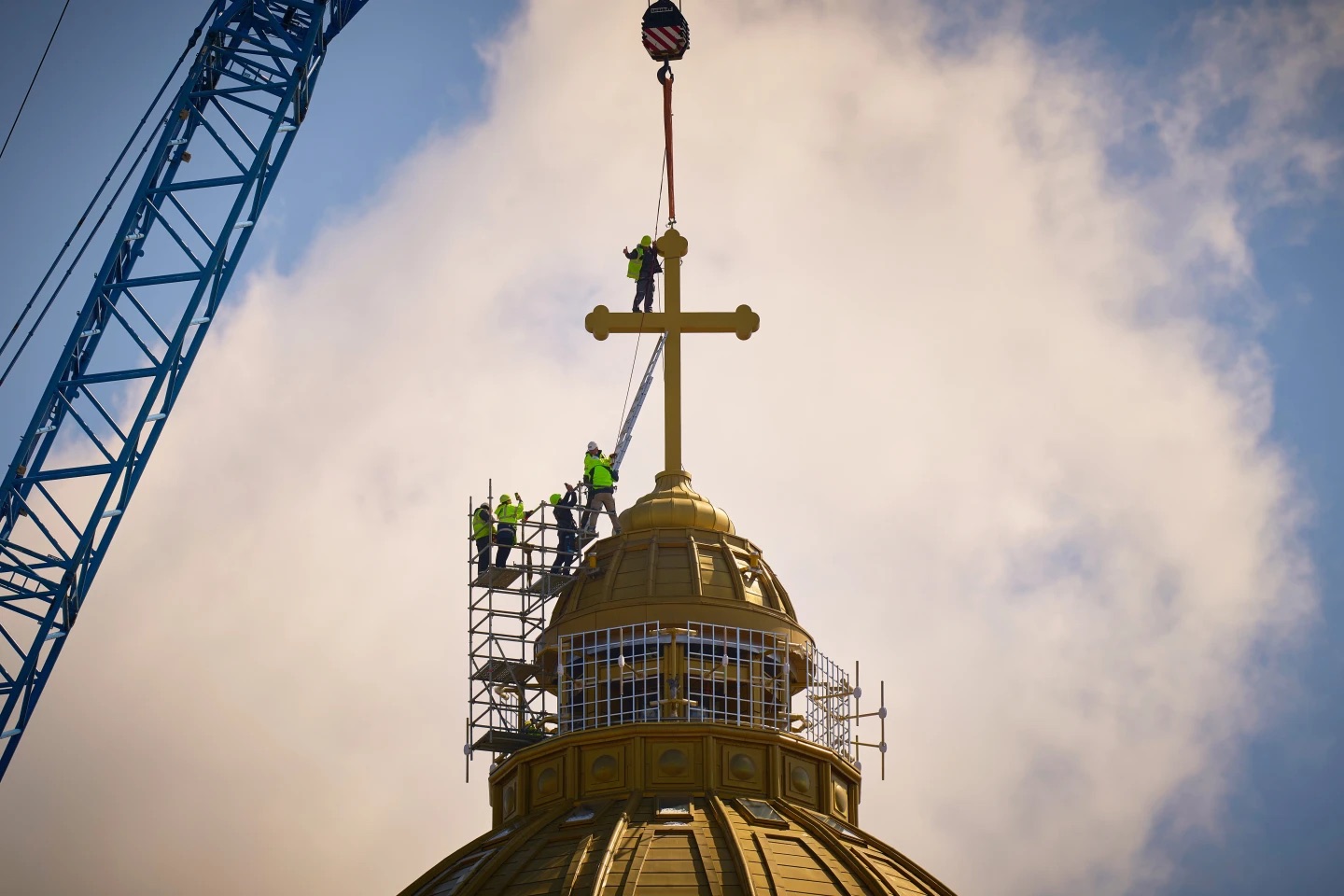


BUCHAREST, Romania (AP) — Thousands of pilgrims turned out Sunday in Romania’s capital for the consecration of religious paintings inside the world’s largest Christian Orthodox church that was being opened after 15 years of construction.
Worshippers and officials arrived in droves at the People’s Salvation Cathedral, known as the National Cathedral, which at its highest point stands more than 125 meters (410 feet) and has an inner capacity for 5,000 worshippers in the deeply Orthodox country. The cathedral’s opulent interior is covered with frescoes and mosaics depicting saints and icons.
Proposals for a national cathedral in the country of about 19 million people had been put forward for more than a century, but its fruition was hampered by two world wars and the decades of communist rule, which sought to suppress religion. The Romanian Orthodox Church has called the cathedral “a symbol of national identity.”
Romania is one of the most pious countries in the European Union, with around 85% of the population identifying as religious.
Situated behind the hulking Palace of the People built by the late communist leader Nicolae Ceausescu, construction for the cathedral finally began in 2010, and its altar was consecrated in 2018. It has so far cost a reported 270 million euros ($313 million), with a majority drawn from public funds, and some works are yet to be completed.
Traffic was restricted for Sunday’s service, which was attended by President Nicusor Dan and Prime Minister Ilie Bolojan. Many worshippers watched via TV screens set up outside the cathedral.
The cathedral’s mosaics and iconography cover an area of 17,800 square meters (191,000 square feet), according the cathedral’s website.
Daniel Codrescu, who has spent seven years working on the frescoes and mosaics, told The Associated Press that much of the iconography has been inspired by medieval Romanian paintings and others from the Byzantine world.
“It was a complex collaboration with the church, with art historians, with artists, also our friends of contemporary art,” he said. “I hope (the church) is going to have a very important impact on society because … it’s a public space.”
With one of the largest budget deficits in the EU, not everyone in Romania was happy about the cost of the project. Critics bemoan that the massive church has drawn on public funds, which could have been spent on schools or hospitals.
Claudiu Tufis, an associate professor of political science at the University of Bucharest, said the project was a “waste of public money” but said it could offer a “boost to national pride and identity” for some Romanians.
“The fact that they have forced, year after year, politicians to pay for it, in some cases taking money from communities that really needed that money, indicates it was a show of force, not one of humility and love of God,” he said. “Economically, it might be OK in the long term as it will be a tourist attraction.”
Rares Ghiorghies, 37, supports the church but said the money would be better spent on health and education as “a matter of good governance.”
“The big problem in society is that most of those who criticize do not follow the activities of the church,” he said.
___
McGrath reported from Leamington Spa, England.