


(RNS) — I first fell in love with playwright Tom Stoppard with an assigned reading in 10th grade.
The audacity of the play, “Rosencrantz and Guildenstern Are Dead,” stunned and moved me, telling the story of “Hamlet” from the vantage point of two minor, almost inconsequential characters. They are baffled by events they can’t fully grasp.
I started thinking about what it meant to allow marginal figures — the ones usually denied the dignity of interior lives — to narrate the story. And, what would happen if we invited other marginal characters to tell great stories from their own perspectives?
Years later, I would learn that there was something Jewish in Stoppard’s move: to live at the edges, and to comment from the margins. I would learn the art of midrash — to allow imagination to fill in the white spaces between the black letters of a text.
When I learned of Stoppard’s death Saturday (Nov. 29) at the age of 88, I thought not only of my first experience with him, but my last with “Leopoldstadt,” the work that would become his final testament.
Named for Vienna’s historic Jewish district, “Leopoldstadt” (2020) tells the story of several generations of the Merz-Jakobovicz family — an epic stretching from the 1890s to the 1950s. Its characters are in various stages of Jewishness: fully Jewish, half-Jewish and ex-Jewish characters who traded synagogue for church and Jewish particularity for the gauzy universalism of 19th-century European liberalism.
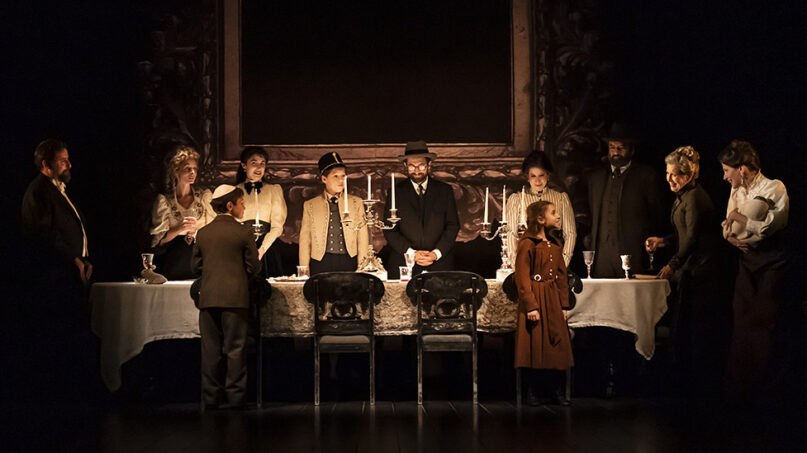
The Broadway company in the Seder scene of Tom Stoppard’s play “Leopoldstadt.” (Photo by Joan Marcus/Leopoldstadt)
But near the end of the play, a roll call of family members speaks of their final destinations: Auschwitz. Auschwitz. Auschwitz. Even those characters who were currently Catholic ended up in the concentration camp.
It was Stoppard’s own story.
Late in life, Stoppard discovered he was Jewish. Born Tomáš Sträussler in present-day Czech Republic in 1937, he fled with his family from the Nazis when he was a toddler. When he later asked his mother if they had been Jewish, she dismissed the question — as if Jewishness were a smudge one tried politely to wipe away.
But in the early 1990s, Stoppard found out from a cousin that he was, in fact, entirely Jewish. All four of his grandparents and many other relatives were killed in the Holocaust.
“Leopoldstadt” was his act of memory and his Jewish reckoning. But it was also the most powerful statement of Zionism in modern culture.
Near the play’s beginning, we witness a debate between the newly Catholic Hermann and Ludwig, who recognizes the nascent antisemitism pulsating through Vienna. They discuss a new essay by Theodor Herzl, the founder of modern Zionism.
Hermann scoffs. Vienna, he insists, is a paradise of culture and tolerance. Antisemitism is passé. His social stature is secure. Ludwig is unconvinced.
We in the audience, of course, know the future. We watch them debate as if we are watching someone refuse to evacuate before a hurricane. We want to shout: Get out. You don’t understand what is coming. You cannot culture your way out of hatred.
But that is the triumph — and the tragedy — of Stoppard’s play. He forces us to confront how seductive complacency can be, how rational it seems in real time, how deadly comfort can become.
Then, Hermann recalls how a man knocked his grandfather’s hat into the street. “What did you do?” Hermann asks. “I picked up my hat,” the grandfather replies. This incident — and response — really happened to Sigmund Freud’s grandfather, Jacob. According to the Museum of the Jewish People, a Christian boy approached Freud’s grandfather on the street and yelled, “Jew, get off the sidewalk,” knocking his hat into the mud.
It was the memory of that incident that helped propel Freud toward Zionism. It meant the stubborn refusal never to be a victim again.
At the end of the play, we meet Leonard Chamberlain, a descendant who lives in England without knowledge of his Jewish beginnings. Nathan Fischbein, a Holocaust survivor, confronts him with tenderness and grief, saying, “You live as if without history, as if you throw no shadow behind you.”
For most of his life, Stoppard lived like Rosencrantz and Guildenstern — on the margins of his own story, unaware of the larger drama that shaped him. But Chamberlain was Stoppard, at last stepping into the center and reclaiming the shadow he had once tried not to cast.
Over two years have passed since “Leopoldstadt” was on Broadway. These years have contained a horrible explosion of antisemitism in America and around the world, during which many Jews have wondered whether the golden era of American Judaism has ended. Are we like the Jews of Vienna?
“Leopoldstadt” was what Stoppard knew. It was the very opposite of Blanche DuBois in “A Streetcar Named Desire,” who says she relied “on the kindness of strangers.” You cannot build Jewish safety on the goodwill of others.
Stoppard spent a lifetime charting the spaces between identity and oblivion, between the margins and the center of the story. And yet, in this last play, he finally stepped into his own narrative, acknowledging the weight of ghosts and the reach of memory. He left us with an elegy for a people, for a lost world, and — unknowingly — for himself.
May his memory be a blessing.