


Meet the African women bishops attending the archbishop of Canterbury's installation
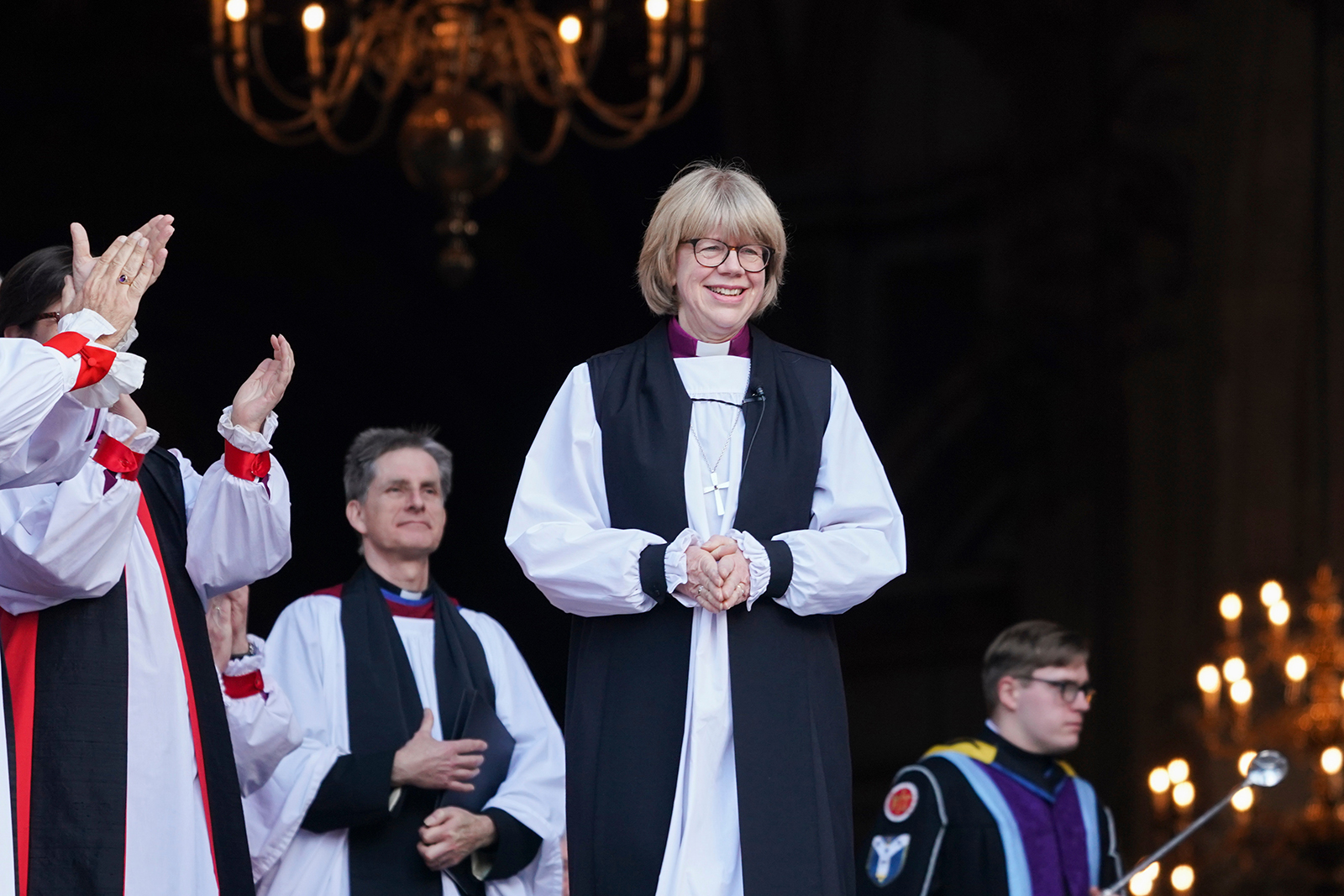


NAIROBI, Kenya (RNS) — Five African Anglican women bishops said they will attend the historic installation of the first female archbishop of Canterbury, even as GAFCON, an alliance of conservative primates strongly represented in Africa, has urged a “principled disengagement” from the traditional center of Anglican power in England.
The Most Rev. Sarah Mullally, a 63-year-old former nurse, will be installed on Wednesday (March 25) at Canterbury Cathedral in England, the final step in making her the head of the Church of England and the convener of the worldwide Anglican Communion. She is the 106th archbishop of Canterbury and the first woman to hold the office in the church’s 1,400-year history.
“We are standing in solidarity with the archbishop of Canterbury,” the Rt. Rev. Rose Okeno, bishop of Butere, in Kenya, told Religion News Service, “strongly witnessing the love of Christ that transcends all social, religious, economic, cultural and political barriers, and which affirms the dignity of all humans as equal, created in his image, imago Dei.”

Top row, from left: the Rt. Revs. Rose Okeno, Vicentia Kgabe and Emily Onyango. Bottom row, from left: the Rt. Revs. Dalcy Badeli Dlamini and Filomena Tete Estêvão. Photos courtesy of (respectively) Giluwa/Wikimedia/Creative Commons, Durham Diocese, Diocese of Bondo, Anglican Communion Office and MANNA
The other African women bishops who will attend the installation in Canterbury are the Rt. Revs. Filomena Tete Estêvão, bishop of Bom Pasteur in Angola; Vicentia Kgabe, bishop of the Diocese of Lesotho; Emily Onyango, an assistant bishop of Bondo, Kenya; and Dalcy Badeli Dlamini, the bishop of Eswatini.
Rounding out the so-called Africa Six — a collective reference to the six Anglican women bishops in Africa — is Elizabeth Awut Ngor, an assistant bishop of the Diocese of Rumbek, South Sudan, who said she would miss the installation due to local commitments in her area.
The five who are attending are doing so in defiance of the wishes of the bishops of GAFCON, the Global Fellowship of Confessing Anglicans, who rejected Mullally’s appointment at a gathering in Abuja, the capital of Nigeria, in early March. While the group shelved a plan to elect a rival to the archbishop of Canterbury, the prelates launched the Global Anglican Communion, which they declared to be the legitimate family of Anglican churches, and elected leaders to sit on a Global Anglican Council.
Besides opposing the consecration of women bishops, the prelates accuse Mullally of repeatedly promoting unbiblical teaching on marriage and sexual morality. But their chief complaint is that her appointment further divides a communion already tested by a wide range of views on gender and sexuality.
Archbishop Laurent Mbanda of Kigali, the primate of Rwanda who is chairman of the new council, said after Mullally’s selection was announced in October: “Though there are some who will welcome the decision to appoint Bishop Mullally as the first female archbishop of Canterbury, the majority of the Anglican Communion still believes that the Bible requires a male-only episcopacy. Therefore, her appointment will make it impossible for the archbishop of Canterbury to serve as a focus of unity within the communion.”
Okeno, a 57-year-old mother of four, was made the bishop of Butere, home to small-scale farmers and traders in western Kenya, in 2021 despite an informal moratorium on the ordination of women demanded by GAFCON three years before. A strong advocate of environmental stewardship, Okeno said she is attending Mullally’s installation to pray, witness and listen.
“This is how we converse,” she said. “We remain part of the body even when we disagree. It is about keeping space open for the Holy Spirit to work across differences. I attend not because I want to choose sides, but because I still believe in the unity of the communion.”
Asked if she was supporting Mullally because she is a woman, Okeno warned against reducing the debate over Mullally to any single issue. “Archbishop Sarah Mullally is the 106th archbishop of Canterbury and the leader of the Anglican Communion. I would attend if a male bishop had been elected,” she said, adding that what mattered most was that the gospel was being proclaimed and that the church was being led faithfully.
She stressed that her decision to attend Mullally’s installation should be understood as a sign of a continued relationship with the Anglican Communion, not a statement of political alignment. “The Anglican tradition embraces diversity, tension and dialogue,” she said. “We have to talk to each other. I am deeply aware that many African provinces, including voices within GAFCON, are calling for clearer theological boundaries. I’m not dismissing those concerns. I’m choosing and hoping for a conversation.”

Leaders of numerous Anglican churches attend a church service on the sidelines of their meeting of the Global Anglican Communion in Abuja, Nigeria, March 4, 2026. (AP Photo/Olamikan Gbemiga)
Okeno does not agree with all of Mullally’s views but said the relationships in Christ must be larger than the leaders’ disagreements. “I am standing in solidarity with the gospel of peace, love, unity, reconciliation and human dignity,” Okeno said.
Onyango, an assistant bishop of Kenya’s Bondo Diocese and a senior lecturer at St. Paul’s University in Limuru, shared Okeno’s reasoning. “I am attending the installation. I am affirming that God has called Archbishop Sarah as the head of the church,” Onyango said.
While she supported GAFCON’s scriptural literacy arguments, she did not agree with the divisions GAFCON’s dissenting prelates imposed on the church. “I also do not agree with them when they claim that women’s ministry is not biblical,” she said.
Kgabe, bishop of Pretoria, in southern Africa, told NPR last year that she welcomed Mullally’s appointment but was concerned that it would ignite more debate on the LGBTQ question and women bishops in the church. “It starts and sparks a conversation in those dioceses that don’t have women,” said Kgabe.
Badeli Dlamini, the bishop of Eswatini, consecrated in 2022, has served on the international Anglican/Lutheran Commission, an ecumenical group, and is a member of the steering group of the International Anglican Women’s Network. Estêvão, the Angolan bishop, was elected in July 2023, making her the first female bishop in the Anglican Church of Mozambique and Angola. Educated in economics and law in Lisbon, she serves the northern part of Luanda, the capital of Angola, and the surrounding provinces.
Both bishops are also attending, but could not be reached for comment in time for publication.
From South Sudan, where she is in the process of establishing a new diocese, Awut Ngor said she believed Mullally would unite Anglicans. In 2016, Awut Ngor became the third African Anglican woman to be consecrated a bishop, after Margaret Onyango of South Africa, elected in 2012, and the late Bishop Ellinah Ntombi Wamukoya of Eswatini (formerly Swaziland), who was consecrated the same year.
“She has all what it takes to bring communion together,” Awut Ngor told Religion News Service in a telephone interview. “We are supporting and praying for her.”
Mbanda did not respond to requests for comment, but Archbishop Justin Badi Arama, the primate of South Sudan and the chair of the Global South Fellowship of Anglican Churches, said: “I am not attending, but we are praying for them. I know that the primates of the Global South are not attending, but there are some primates and bishops who will attend. For me, this is an occasion of the Church of England and will go well with the support of friends.”