

As some praise Texas’ proposed ‘Judeo-Christian’ curriculum, rabbis say it dismisses Judaism
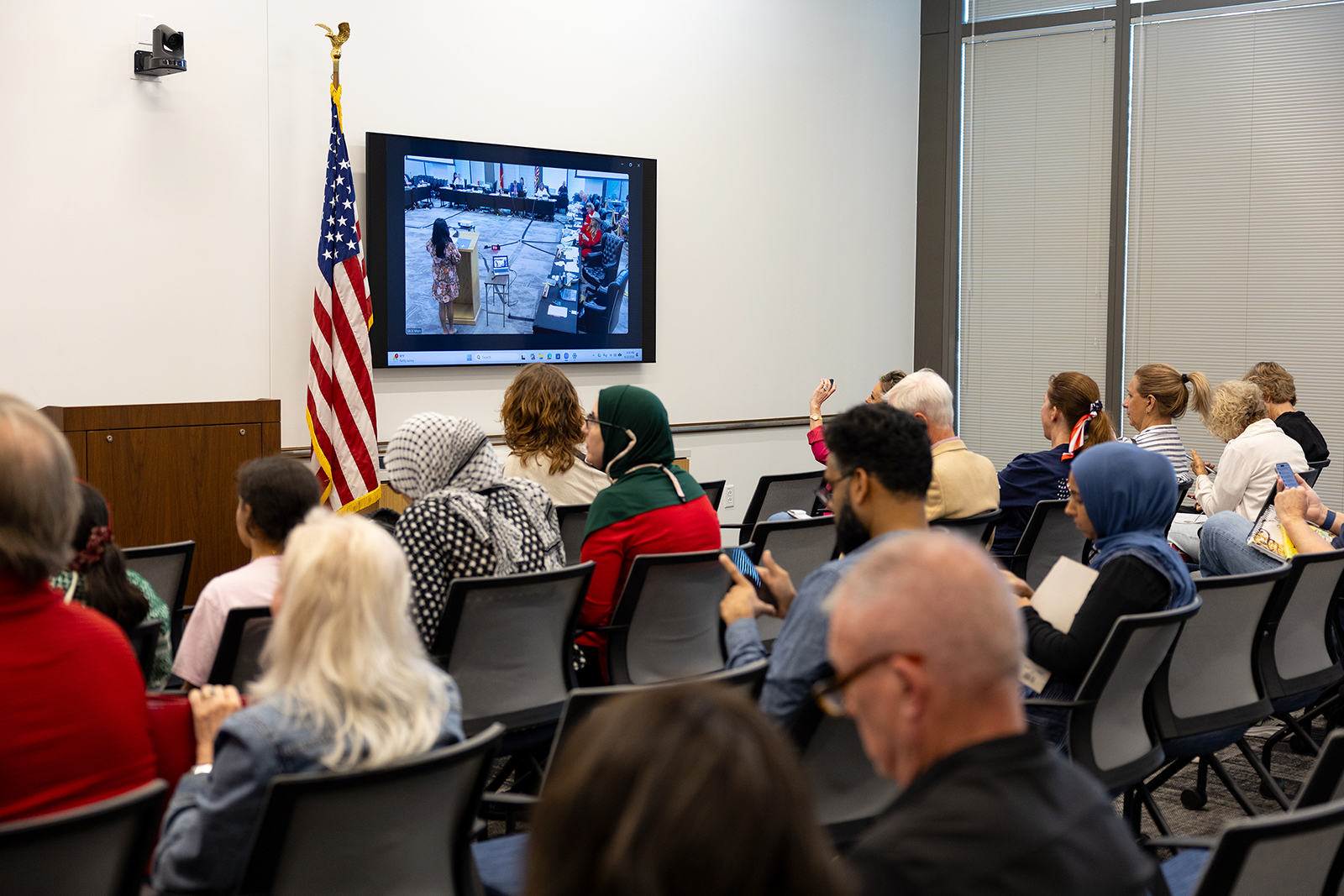


AUSTIN, Texas (RNS) — During a Texas State Board of Education hearing on Monday (June 22), supporters of a proposal to require Texas public school students to read Bible stories argued doing so would acknowledge that the nation was founded on Judeo-Christian values.
Rabbis and Jewish leaders at the hearing, however, criticized the biblical passages chosen by the education board as heavy on Christianity and dismissive of Judaism. Grounding support of the measures in “Judeo-Christian” values is a “fig leaf at inclusion,” one said.
The State Board of Education kicked off a week of meetings Monday by hearing from more than 400 experts, teachers and concerned citizens on two proposals — one that would overhaul the state’s social studies curriculum, and another that would create a required reading list for K-12 public schoolchildren. Both proposals include biblical references, passages and stories. A final vote is expected by Friday.
Many of the speakers who praised the proposed reading list said it was important to teach children about Judeo-Christian heritage and values.
“Don’t lie about where we came from as Americans,” witness Richard Green said. “It was the Judeo-Christian value system that produced the greatest, most powerful, the wealthiest, most free, the most benevolent nation in the history of the world.”
Larry Holland with the conservative grassroots group Citizens for Education Reform endorsed the reading list because it was aligned with “a nation founded on the principles of Judeo-Christian heritage.”
However, several rabbis and Jews rejected the use of “Judeo-Christian” to support the list.
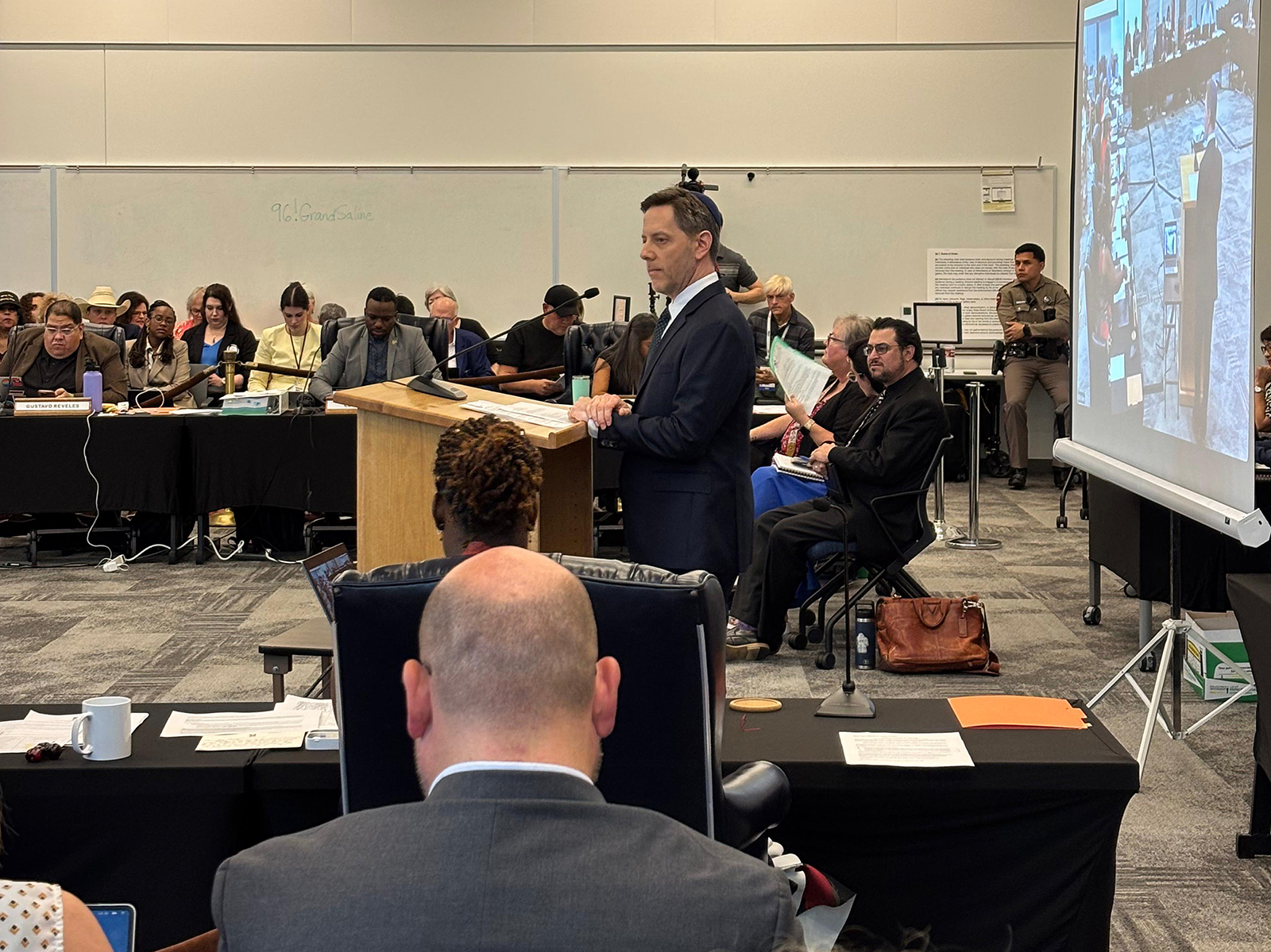
Rabbi David Segal addresses the State Board of Education in the Barbara Jordan Building on Monday, June 22, 2026, in Austin, Texas. (Photo courtesy of Segal)
“One would think that this phrase is meant to evoke friendship between the two faiths, but I do not find that here — or in the language surrounding support for this list,” said Blake Ziegler, a Texas field organizer for the Religious Action Center of Reform Judaism.
Cameron Samuels, executive director of Students Engaged in Advancing Texas, a group that aims to incorporate young people in state policy decisions, objected to using “Judeo-Christian” to characterize Texas values.
“Not in my Jewish faith shall you mandate entire chapters of the Bible for over five-and-a-half million students in Texas and proclaim that this speaks for Jewish people,” Samuels said.
‘A fig leaf at inclusion’
The term Judeo-Christian was popularized during the Cold War — a conflict frequently characterized as a spiritual battle between those of faith and “godless” enemies abroad, said Robert O. Smith, associate professor at the Lutheran School of Theology at Chicago.
In the United States, the term united Protestants, Catholics and Jews under a banner of shared religious origins that excluded Muslims, he said.
“The Protestant, Catholic, Jew construct” of the Judeo-Christian ethos is based on the “rejection of the atheist and the rejection of the Muslim,” Smith said in an interview.
Though Judaism is embedded in the phrase, the partnership has not been equal, Smith added. The term Judeo-Christian “implies a Christian construction of Jewish existence” in which “Jews exist inherently to fulfill Christian purposes,” he said.
“Christianity, from its very beginnings, has had a very ambivalent relationship with Jews and Judaism,” Smith said. “There’s a desire for Jews to convert — and therefore for Judaism to disappear into Christianity — but there’s also a recognition that Judaism is the foundation of Christianity.”
For many of the Jewish leaders who testified before the State Board of Education, the required readings signified the contradictions behind the term Judeo-Christian.
Of the roughly dozen scriptural passages included in the proposed student reading list, many were taken from the Hebrew Bible — the shared text between Jews and Christians — but most of the excerpts are from distinctly Christian translations.
Ziegler and Houston Rabbi David Segal criticized the reading list’s inclusion of Lamentations 3, the only biblical passage taken from the Tanakh, the Jewish translation of the Hebrew Bible. The Texas curriculum requires using a translation produced in 1917 by the Jewish Publication Society, and many contemporary Jewish communities no longer use it.
Ziegler told the education board that the translation was outdated and he was concerned that the passage’s “graphic violence isn’t appropriate for eighth grade.”
Lamentations 3 details the physical, mental and spiritual effects of God’s wrath on those who stray from him.
Ziegler also criticized placing Lamentations 3 alongside Holocaust literature, like Elie Wiesel’s “Night,” in the curriculum.
“Lamentations understands the destruction of the ancient temple in Jerusalem as God’s punishment for the Israelites’ sins,” he said. “When it’s taught alongside Holocaust literature — suggesting that was similarly a divine punishment for Jews — that is an unacceptable implication that invites antisemitism and hurts Jews across the state.”
Segal agreed. “Of course, (the translation) is outdated, but worse, you’ve anchored it to Holocaust literature, which invites eighth graders to consider whether the Holocaust was God’s punishment for the Jews,” he told the board.
“I assume this poor choice comes from ignorance, not intent, but either way it’s unacceptable, as is the proposed list as a whole, which I ask you to reject and start over,” Segal said.
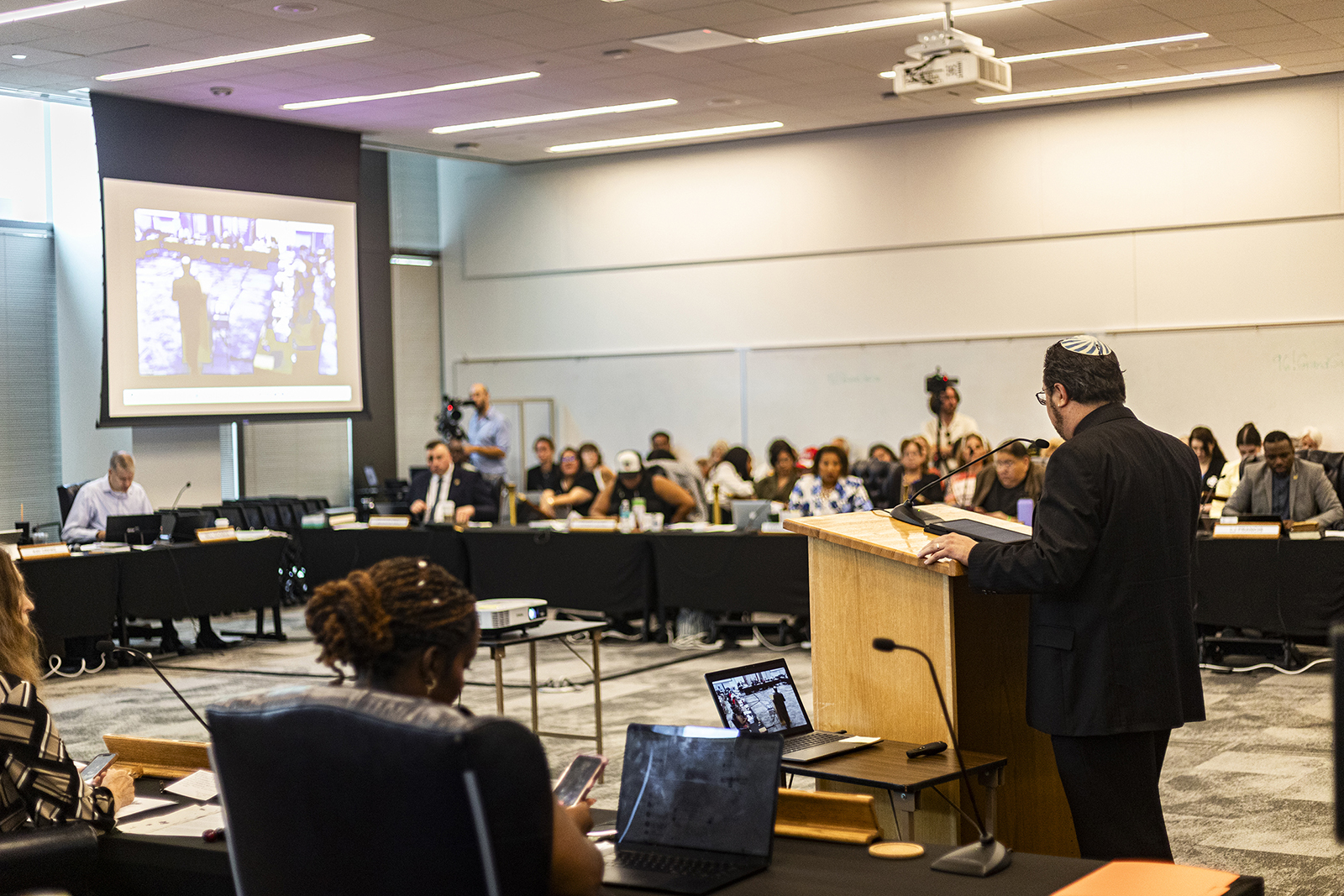
Rabbi Josh Fixler addresses the State Board of Education in the Barbara Jordan Building on Monday, June 22, 2026, in Austin, Texas. Fixler argued that the required reading list is full of Christian texts that are inappropriate for public school classrooms. (Photo by Aiden Gonzalez/The Texas Tribune)
Rabbi Joshua Fixler, rabbi at Houston’s Congregation Emanu El and a member of the Religious Action Center, said the curriculum’s near-exclusive use of Christian interpretations and Scriptures will result in the “further alienation of non-Christian students.”
Speaking after his testimony, Fixler said he is almost always troubled by invocations of “Judeo-Christian,” which to him “make actions that Christians are doing seem more inclusive by including Jews in the phrase.”
“It feels like a fig leaf at inclusion,” Fixler said. “They’re promoting a particular version of Protestant Christianity in our public schools and trying to use Jews as cover by using the term Judeo-Christian.”
‘Pride in our moral, cultural and civic traditions’
Several speakers told the education board that the proposed reading list honored the nation’s Judeo-Christian heritage and values.
Susan Perez of Citizens for Education Reform said the “nation was founded on Judeo-Christian values,” adding that aspects of the American judicial system “were set up under Moses in the Bible.”
Kason Huddleston, a pastor from Rockwall, said the reading list would create “strong readers … who love America and understand our Constitution and the Judeo-Christian foundations.”
“We do not need to emphasize other cultures like Islam,” Patricia Franklin of Lubbock told the board of education. Focusing instead on Judeo-Christian ideas “will foster our students’ understanding and pride in our moral, cultural and civic traditions,” she said.
Laurie Cardoza Moore, the evangelical Christian founder of Proclaiming Justice to the Nations, a group that mobilizes support for Israel, emphasized Judaism’s impact on Western civilization.
“For more than two decades, PJTN has warned that anti-Israel propaganda and historical revisionism and ideological activism are entering classrooms,” she said.
“Students are being exposed to narratives that minimize the Jewish roots of Western civilization, distort the history of Israel, ignore the contributions of the Jewish people to America’s founding,” she said.
The Judeo-Christian Caucus says it unites pastors, legislators and citizens to “uphold and promote our Judeo-Christian heritage.” Contacted by email, Dran Reese, president of the group, said the term Judeo-Christian recognizes Christianity’s heritage “and affirms the timeless moral and ethical principles shared by both Jews and Christians.” The group was not represented at the hearing.
“United by these common values,” Reese said, the caucus seeks “to strengthen faith, family, freedom, and the biblical foundations that have blessed our nation and civilization.”
Fixler, the rabbi from Houston, has a different perspective. Though Jews were in the U.S. at its founding, he said, “we were not the Founding Fathers.” Using “Judeo-Christian” to describe the nation’s origin is “a prime example” of how the term rewrites the Jewish experience, he said in an interview.
The Founding Fathers were a “group of men representing a variety of religious beliefs” who built “the world’s first government that was explicitly not rooted in religion,” he said.
Fixler wore a tie depicting the Constitution when he testified before the education board — a choice he later said reflected his concern that the “sacred principles of the United States Constitution and our secular democracy were under threat.”
“The reading list and the social studies standards are part of a concerted effort to chip away at the wall of separation between church and state, which has been so important to people of all faiths in America for its 250-year history,” he said.
For Fixler, there is “a big difference between teaching about religion and teaching religion.” In his view, the list accomplishes the latter, and he would rather the vast majority of scriptural references be eliminated.
The Jewish Federations of Texas and Shalom Austin, a Central Texas Jewish group, recommend using the 1985 Jewish Publication Society translation for passages from the Hebrew Bible, as well as additional representations of the Jewish experience beyond Holocaust literature.
Segal is similarly open to including some scriptural passages on the reading list.
“I do think it should be taught” to foster religious literacy, Segal said in an interview. But he said Jewish texts should not be taught “through a Christian lens” or be insensitively paired with Holocaust literature.
Ziegler said if lessons include religious texts, “they should reflect the diversity of our society.”
“The First Amendment does not permit the state to anoint one religious tradition above others. Texas students deserve an education that broadens their understanding of the world’s religious traditions, rather than narrowing it,” he said.
This story is published through a collaboration between The Texas Tribune and Religion News Service.