


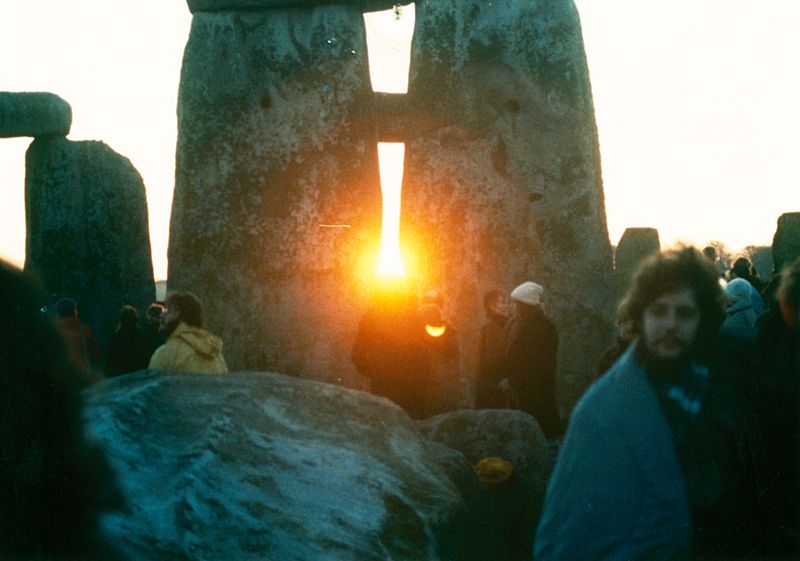


Dec. 21 is the winter solstice, seen by many worldwide — including people watching the sun at Stonehenge in England — as a spiritual event.
Here comes the dark. The winter solstice — marking the longest night and shortest day of the year — is Monday night.
The solstice occurs at the same instant everywhere on Earth. In the United States, it happens at 11:48 p.m. ET Monday (or 10:48 p.m. CT, 9:48 p.m. MT and 8:48 p.m. PT).
In Europe, Africa, Asia and Australia, that means the solstice actually comes on Tuesday.
The winter solstice is the precise moment the Northern Hemisphere is tilted its farthest from the sun all year, and usually occurs near the day when there is the least amount of daylight and the most darkness.
One of the most famous solstice celebrations occurs at the ancient Stonehenge ruins in Wiltshire, England, where druids, pagans and other revelers gather each year to celebrate the event.
READ: Secular Solstice: Doing good for goodness’ sake
The solstice is the astronomical beginning of winter — the start of the coldest three months in the Northern Hemisphere — even though meteorologists view winter as starting Dec. 1. After the solstice, the days slowly start to get longer again.
It’s the opposite in the Southern Hemisphere, where Dec. 21 marks the longest day of the year and the beginning of astronomical summer.
Winter’s shortest day, however, is typically not the coldest day of the year. There is a lag between the shortest day of the year and the coldest average temperatures for most spots in the USA.
This lag in temperature occurs because even though the amount of daylight is increasing, the Earth’s surface continues to lose more heat than it receives from the sun. In most locations across the country, the minimum daily temperature occurs around two or three weeks later, in early to mid-January.
READ: Christmas is all about Jesus’ signs pushed by pastors
For example, the coldest days in Boston, on average, are Jan. 17-26. In Chicago, it’s Jan. 17-20, and in Miami, it’s Jan. 2-22. At the end of January, more heat finally begins arriving than leaving, and days slowly start to warm up.
The Earth’s tilted axis causes the seasons. During the Northern Hemisphere’s winter, the land north of the equator is tilted away from the sun, which lowers the amount of the sun’s energy warming the Northern Hemisphere.
And why is the Earth tilted? It’s probably the result of collisions with various proto-planets and other massive objects during the formation of the solar system billions of years ago, according to NASA. Just a bit unsettling to realize that the reason the Earth has the perfect temperature for life to form is a few random collisions with other space rocks a few eons ago.
In the meantime, happy solstice!