


East-West Travelblog: Taking 'divine music' out of the mosque
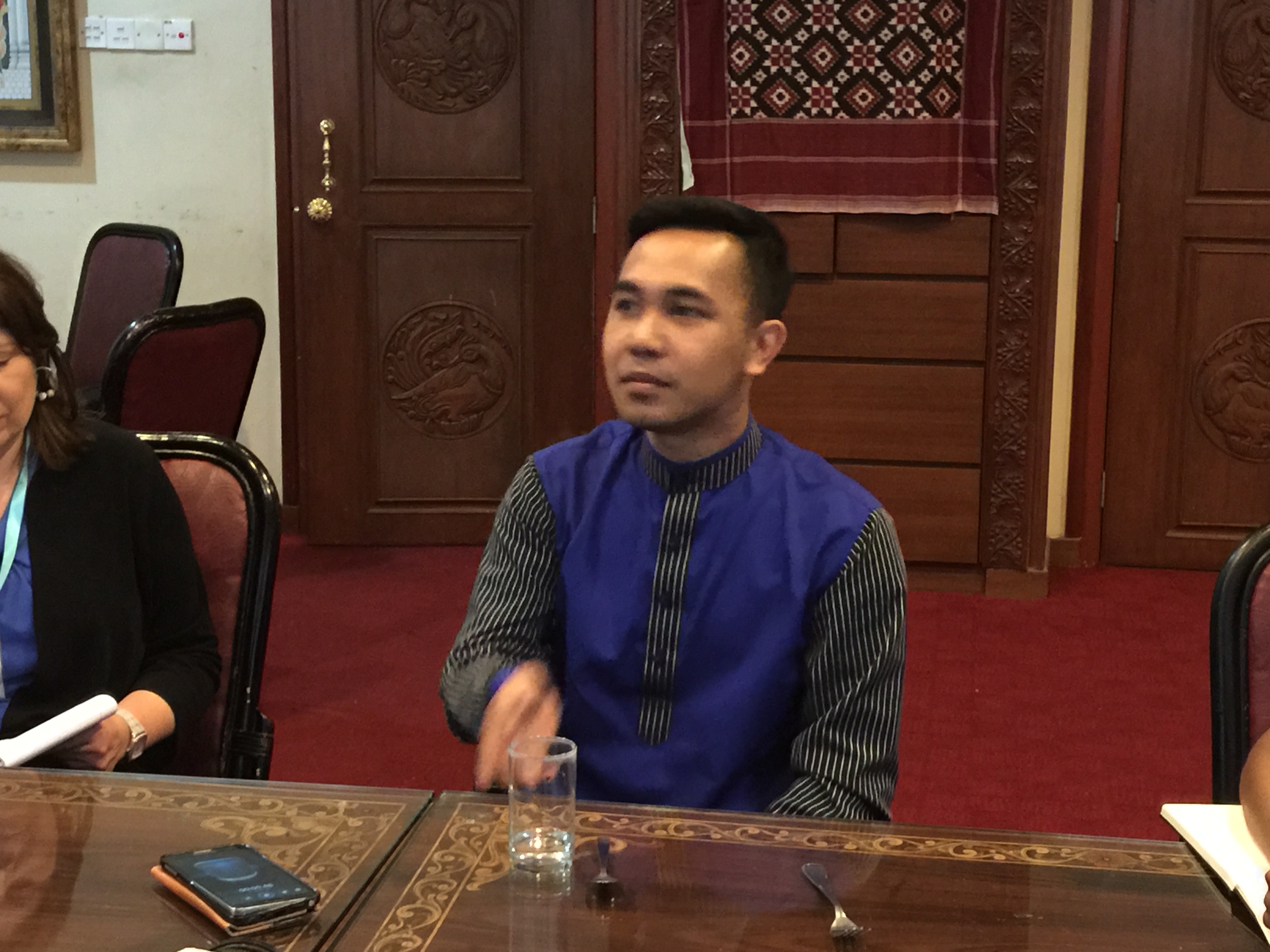


KUALA LUMPUR, Malaysia (RNS) Christians have praise music. Muslims have nasyid.
Nasyid, a form of sung music in which a phrase or word of praise is repeated, is super popular among Muslims — especially young Muslims — and there are concerts, festivals and competitions all around the world.
We learned about nasyid from Hafiz Hamidun, a chart-topping Malaysian nasyid composer and performer who met with me and the 17 international journalists I am traveling with as part of the East-West Center’s seminar for senior journalists.
“I love divine music,” Hamidun said over tea at a Hindu restaurant in this capitol city. “I love Christian music, I love Jewish music, I love it all. But I am Muslim so I choose” nasyid.
Hafiz Hamidun, Malaysian nasyid singer
Hamidun used to be part of a Malaysian boy band — yes, they have those, too — and then struck out on his own a few years ago. His first couple of pop albums bombed, he told us, and then he recorded “Zikir Terapi Deri,” an album of nasyid (zikir is a form of silent chanting.)
The album sold more than half a million copies — huge for nasyid — and he made another. Now he is working on album he described as devotional music that draws on world traditions.
But in a country where even the language of Islam is legislated, it is not surprising that nasyid is controversial. Some Muslims believe it must only be sung a capella, while others say it can include a few traditional acoustic instruments. Others who like to push the boundaries include synthesizers, electric guitars and other instruments more generally associated with pop and rock.
Hamidun sings with instruments — a piano and some strings, usually. “I take it as permissible,” he said. Then he sang a capella for us.
(video courtesy Tham Seen Hau, Kinitv)
Still, Hamidun has been called before Malaysia’s religious authorities, he told us. But he convinced them his concerts were not overly-commercialized and could serve the people, even though they were not being performed in a mosque, he said.
“I can’t stop,” he said. “Art will never stop. It has to be creative, it has to evolve.”
ANOTHER VIEW: Kim Lawton’s fellowship blog at Religion & Ethics NewsWeekly
TRAVEL ALONG:
POST 9: Who owns the word ‘Allah’?
POST 8: Of monkeys, Diet Coke and a Hindu temple
POST 7: Criticizing the Catholic Church in paint
POST 6: A gospel moment: ‘Oh Happy Day”
POST 5: Radicalization is not a ‘Muslim problem’