


AI will make war worse, Pope Leo warns


This is the fifth of a series of columns by the author on Pope Leo XIV’s first encyclical, “Magnifica Humanitas.” This piece focuses on Chapter 5. For earlier columns, see Chapter 1, Chapter 2, Chapter 3 and Chapter 4.
(RNS) — In the final chapter of “Magnifica Humanitas,” Pope Leo XIV’s first encyclical, he turns his attention to the dangers of using artificial intelligence in war.
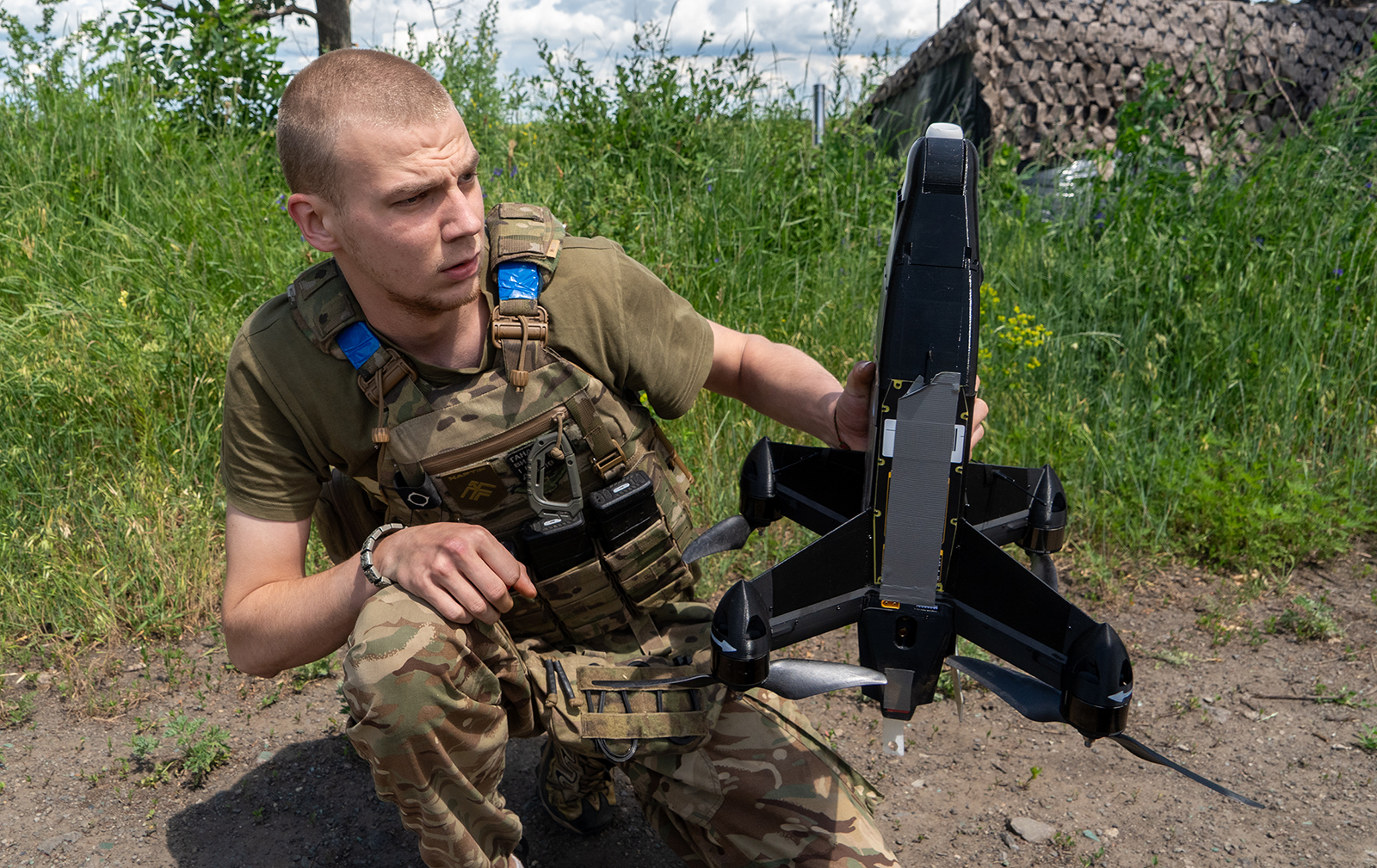
Leo acknowledges that “AI can enhance the defense and protection of civilians.” He might be thinking Ukraine using defensive drones to knock down Russian drones attacking cities and killing civilians. Ukrainians are so good at this that Persian Gulf states are asking for Ukraine’s help defending themselves from Iranian attacks.
But in a culture of power that seeks to dominate, Leo warns, AI “can also lower the threshold for the use of force, shield people from responsibility and foster a culture in which the enemy is reduced to a statistic and the victim to ‘collateral damage.’”
“Technology, detached from ethics and responsibility,” Leo explains, “will render decisions about life and death more rapid and impersonal, and will present the use of force as an immediate and viable option.”
To make sure technologies truly serve humanity rather than subjugating it, Leo argues that they must be judged by the principles of Catholic social teaching.
What is needed, according to Leo, is a culture of love — “a social order in which justice and charity are intertwined and love becomes the guiding principle of economic, political and cultural life.” AI, in that context, must “serve to build a universal human family, with shared rights and duties, where digital proximity becomes a real opportunity for encounter and mutual care,” he suggests.
But this is made difficult by a culture of power where “the availability of resources and the ability to dominate tend to dictate the agenda and criteria for decision-making.”
Leo points out that “the past sixty years have been marked by conflicts of astonishing brutality, often affecting civilian populations on a massive scale, leading to the death of innocent victims, mass displacement, social destabilization and long-lasting wounds.”
President Donald Trump got elected after condemning these “forever wars,” but then started a war with Iran.
Leo criticizes the “military-industrial complex” and countries that supply weapons and “profit from a market that thrives precisely on conflicts.” The United States is the biggest arms exporter in the world. Meanwhile, the real cost of military spending “falls on the poorest, who see resources for health care, education and social services being reduced.”
“Without prejudice to the right to self-defense in the strictest sense,” the pope affirms that the “just war” theory, “which has all too often been used to justify any kind of war, is now outdated.”
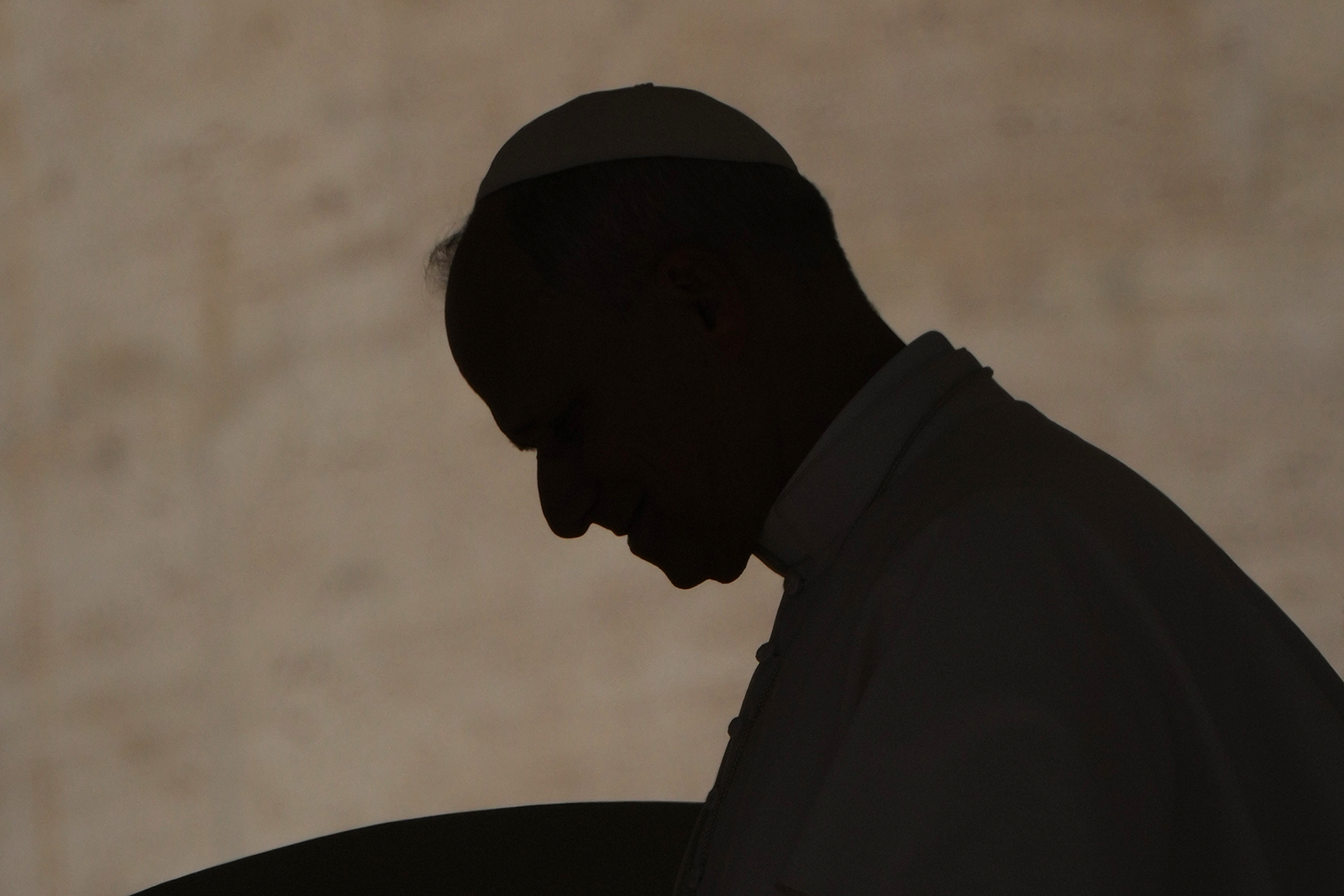
Pope Leo XIV at the Vatican, Oct. 8, 2025. (AP Photo/Andrew Medichini)
As an American, he must be aware of how conservative Catholics have used the just war theory to defend American wars in Vietnam and the Middle East. Rather, he argues, “Humanity possesses far more effective and capable tools for promoting human life and resolving conflicts, such as dialogue, diplomacy and forgiveness.”
Leo goes on to bemoan the weakening of multilateral institutions and systems responsible for the global common good. He does not mention the Trump administration, which has rejected multilateralism, but the shoe fits.
“Peacebuilding has been relegated to a secondary role,” Leo complains. “Cooperation for development, disarmament, conflict prevention and the establishment of mutual trust are neglected in the name of power politics. The achievements of humanitarian law are also being compromised. Indeed, the principle of proportionality in responding to aggression, the protection of access to water, food and essential goods, and respect for the lives of civilians, especially children, come to be regarded as naïve relics of the past.”
While fearing that autonomous weapons systems will make war “more feasible and less subject to human control,” he urges “instilling, as far as possible, values and sound judgment into the artificial systems we build.”
But when they fail, “The chain of responsibility must be identifiable and verifiable,” he says. “Those who design, train, authorize and employ technology must be held accountable for their decisions.”
Nor should speed and efficiency “be the supreme motivating force for the irreversible decisions made in the context of war,” he writes. “Target selection and the use of force must not confuse combatants and non-combatants, nor ignore the impact on defenseless populations.”
The pope brands Realpolitik — “the form of political ‘realism’ that sows in consciences and in society an attitude of resignation to the inevitability of war, and dismisses peace and dialogue as utopian or irrational positions that ignore the risks at stake” — as truly irresponsible.
Instead, Leo calls on everyone to build a civilization of love. “The civilization of love will not arise from a single or spectacular gesture,” he explains, “but from the sum total of small and steadfast acts of fidelity that serve as a bulwark against dehumanization.”
He then proposes five paths toward daily, public responsibility: “the need to disarm words, building peace through justice, adopting the perspective of victims, cultivating a healthy realism and reviving dialogue and multilateralism.”
He calls on us to “examine our conscience regarding the words we use, the prejudices we have and the explicit or implicit aggression that lies within them.”
He affirms that true peace is born of justice. Quoting St. Augustine, he writes, “Do you therefore wish to attain peace? Then practice justice!”
But in some conflicts, he acknowledges it is unjust to remain neutral. “When we witness the bombing of civilians, attacks on hospitals, schools or vital infrastructure, and violence that affects children, we are confronted with scandals that wound humanity itself,” he writes. Fighting in the Middle East too often follows this pattern, although Leo again fails to name names.
If we listen to the voices of victims, he states, we “become aware of the abyss of evil inherent in war, and generally in all forms of violence.”
Leo also calls for “a healthy realism that avoids both political idealism and cynicism.” A healthy realism “starts by clearly identifying interests, fears, constraints and power dynamics, precisely in order to determine what can be achieved, and the measures needed to achieve it.”
“There is an urgent need,” he says, “to shift from the ‘culture of power’ to a genuine ‘culture of negotiation,’ in which dialogue and diplomacy become the standard means of resolving conflicts.”
Leo believes that “if we experience authentic encounters with others, with those who are different, strangers and migrants, it becomes much more difficult even to imagine war.”
On the other hand, “Communication networks, fragmented information environments and algorithms that reward conflict,” he says, “can magnify polarization and resentment, increase propaganda and make shared discernment more difficult.”
“Cyberspace too has become a battleground,” Leo notes. “Cyberattacks, data manipulation and campaigns of influence, orchestrated with the help of AI, can destabilize entire countries even before open armed conflict erupts.”
He therefore calls for negotiations to develop “shared regulations on the use of digital technologies, in order to protect civilians and the most vulnerable from ‘invisible’ yet real forms of violence.”
Many will think that calling for diplomacy, dialogue and a civilization of love is naïve, but the alternative is constant war. Leo sees this and wants to put the Catholic Church on the side of peace. This is urgent, before AI makes war even more inevitable and dangerous, he argues.