


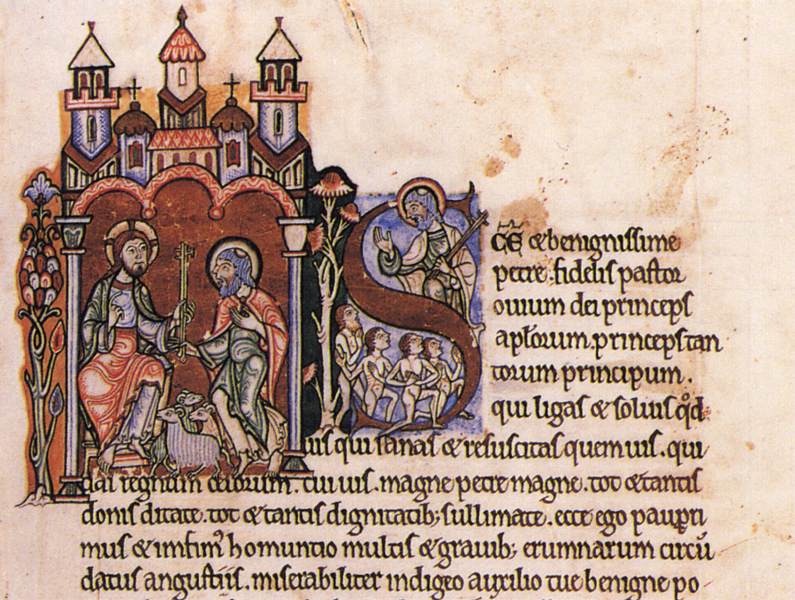


12th-century manuscript of the Meditations of St. Anselm
“What do you get when you cross Tony Soprano with a natural law philosopher?” asks my friend Mark Massa, S.J., dean of Boston College’s School of Theology and Ministry. “Someone who makes you an offer you can’t understand.”
The same point is made, more ponderously to be sure, in the Vatican’s just released preparatory document for the upcoming Synod of Bishops on the family. Reporting on the results of the questionnaire distributed by the Holy See to Catholics worldwide, the Instrumentum Laboris states, “In a vast majority of responses and observations, the concept of natural law today turns out to be, in different cultural contexts, highly problematic, if not completely incomprehensible.” Ouch.
This does not only matter to the church insofar as it struggles to communicate its moral teachings to the faithful. As the document notes (quoting the International Theological Commission’s 2009 report, In Search of a Universal Ethic: A New Look at the Natural Law), “The natural law responds thus to the need to found human rights on reason and makes possible an intercultural and interreligious dialogue.” It is what makes possible — provides the rationale for — the church’s public advocacy on behalf of its moral positions in secular societies like our own.
In the church’s view, natural law is binding on all people because it is written into the nature of things and is therefore, by definition, accessible to all people by reason, not revelation. And yet, as the Instrumentum Laboris acknowledges, the foremost expression of reason in the contemporary world rejects it: “Today, in not only the West but increasingly every part of the world, scientific research poses a serious challenge to the concept of nature. Evolution, biology and neuroscience, when confronted with the traditional idea of the natural law, conclude that it is not ‘scientific.’”
What to do? Interestingly, the document suggests recourse to the Bible as a way of making natural law more comprehensible.
In particular, the vast majority of responses and an even greater part of the observations request that more emphasis be placed on the role of the Word of God as a privileged instrument in the conception of married life and the family, and recommend greater reference to the Bible, its language and narratives. In this regard, respondents propose bringing the issue to public discussion and developing the idea of biblical inspiration and the “order in creation,” which could permit a re-reading of the concept of the natural law in a more meaningful manner in today’s world.
In other words, the way to make reason more comprehensible in today’s world is through revelation. I suppose this comports with St. Anselm’s thousand-year-old notion of “faith seeking understanding.” But it doesn’t say much for natural law as a self-sufficient, universally graspable system of thought.