

Los Angeles City Council adopts definition of antisemitism amid rise in hate incidents
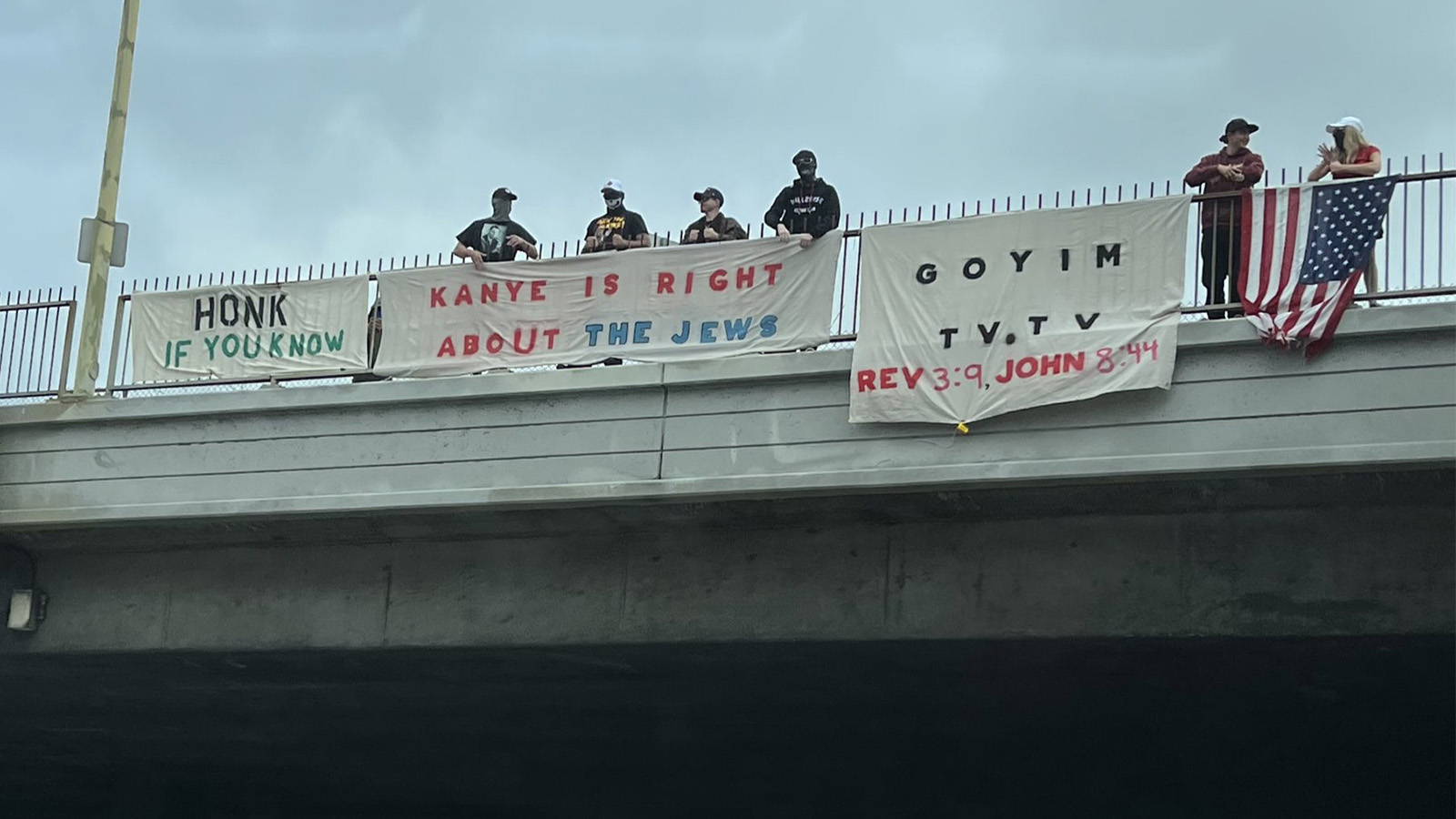


LOS ANGELES (RNS) — With antisemitism cases on the rise — and after a public display of antisemitic signs in LA, inspired by recent remarks of Kanye West — the Los Angeles City Council has adopted a definition of antisemitism to aid law enforcement and public officials in identifying and monitoring such hate incidents.
Council members on Tuesday (Nov. 1) approved the definition — which is not legally binding — from the International Holocaust Remembrance Alliance that supporters, during the meeting, said is an important step in combating antisemitism. Not all agreed, though.
The working definition from IHRA states: “Antisemitism is a certain perception of Jews, which may be expressed as hatred toward Jews. Rhetorical and physical manifestations of antisemitism are directed toward Jewish or non-Jewish individuals and/or their property, toward Jewish community institutions and religious facilities.”
The IHRA gives 11 examples of antisemitism, which range from “Calling for, aiding, or justifying the killing or harming of Jews in the name of a radical ideology or an extremist view of religion” to “Holding Jews collectively responsible for actions of the state of Israel.” More than half of the examples relate to Israel.
RELATED: To define or not to define antisemitism? That’s a good question.
Groups like If Not Now LA and LA Jews for Peace have spoken against the adoption of this definition.
Jeff Warner, with LA Jews for Peace, said during the meeting that the definition “blurs the distinction between antisemitic speech and legitimate criticism of Israel and Zionism.”
“This causes confusion, while delegitimizing the voices of Palestinians and others, including Jews like me, who criticize Israel and Zionism,” Warner said. “None of this helps to combat antisemitism.”
Warner offered the council an alternative known as the Jerusalem Declaration on Antisemitism, an effort signed by more than 200 Jewish academics from around the world that includes “a preamble, definition, and a set of 15 guidelines” to recognize antisemitism.
Debi Graboff, of the Jewish Federation, said during the Tuesday meeting that adopting the IHRA definition is “an important step in the right direction.”
“A crucial first step in fighting antisemitism is defining it in a way that reflects the lived experiences of Jewish people. That is the purpose of the IHRA working definition,” Graboff said.
The IHRA definition has been adopted by 37 United Nations member countries, including the United States, and 320 nonfederal government entities, including 22 states within the U.S. and several cities, according to the resolution the City Council passed. Other cities include Beverly Hills and West Hollywood.
RELATED: White House condemns Kanye-fueled antisemitic freeway demonstration in Los Angeles
Los Angeles City Attorney Mike Feuer said the council’s actions come at a time when not only are antisemitic cases on the rise, but as “celebrities now attempt to normalize antisemitism through explicitly condoning or advocating it.”
“This is an opportunity to take this step today, to say, ‘We stand with those in the Jewish community who unfortunately are grappling with record levels of antisemitism at a time when our nation so desperately needs us to stand up for each other,'” Feuer said.
City officials cited Anti-Defamation League stats that found there was a 34% increase in antisemitic incidents in the U.S. in 2021, compared with the previous year. It’s the highest number on record since the ADL began tracking antisemitic incidents in 1979.