

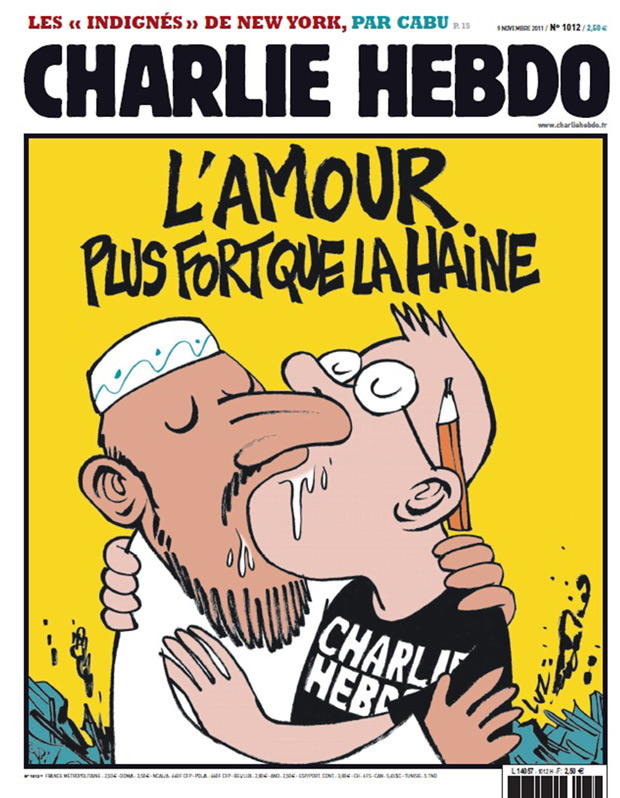


November 8, 2011, cover of Charlie Hebdo magazine after the magazine’s office was attacked by firebombing. The title reads, “Love is stronger than hate.”
I’ve spent much of the past three days sifting through op-eds and flipping through talking heads. Everyone’s got something to say about Charlie Hebdo. My initial reaction? #JeSuisCharlie. Here’s what else I’ve heard:
- Way to go, terrorists! (ISIS, al Qaeda, Satan)
- Charlie Hebdo sorta had it coming (Catholic League president Bill Donohue)
- This isn’t Islam (~1.6+ billion Muslims)
- We vociferously condemn this heinous attack/…sorry (understandably frightened Muslims)
- For the last time, stop apologizing for something you neither did nor endorsed, ~1.6+ billion Muslims! (anyone with common sense)
- Saying the attack was simply about images of Muhammad plays into racist/anti-Muslim tropes (Hussein Rashid)
- We can defend Charlie Hebdo’s right to publish without sacralizing its sometimes Islamophobic, homophobic, misogynistic, and racist content (our very own Chris Stedman and Sarah Jones)
- We’re scared (The Telgraph, The New York Daily News, American television)
- We must defend freedom of expression (fans of the First Amendment and Article 19)
- We must republish the cartoons (my former colleagues at Index on Censorship)
On Wednesday, one of the gunmen was heard to shout, “We killed Charlie Hebdo.” Yet with help from French and global media groups, Charlie Hebdo will live for at least another week.
Whatever you think of the magazine, this is good news. Wednesday’s attack was an assault on freedom of expression. The gunmen intended to silence Charlie Hebdo and its staff.
In his column for RNS, Hussein Rashid writes of Charlie Hebdo’s legacy, “It did not matter if the images were going after Muslims, blacks or Jews; it was always about reinforcing racial and religious hierarchies.”
Charlie Hebdo has always been about satire. “Reinforcing religious hierarchies” is anathema to its mission. Yes, the magazine’s caricatures sometimes rely on racist tropes, but that doesn’t inherently mean it’s “reinforcing racial hierarchies.” That’s not how satire works.
I do not consider myself racist, homophobic, Islamophobic or misogynistic. “Being Charlie” doesn’t mean being any of these things, despite what you think about the magazine’s tact and tone. Neither does republishing the cartoons.
As advocates for freedom of expression we must sometimes defend views we find repulsive. This doesn’t require us to endorse them.
In this case, we must protect what gunmen tried to kill, a satirical magazine some deem offensive.
#JeSuisCharlie simply means, “I defend freedom of expression.” It means showing solidarity with our fellow journalists, columnists, satirists and free speech advocates in Paris and around the world.
Part of me wishes #JeSuisCharlie meant having the bravery to persist after threat or attack without missing a beat, as Charlie Hebdo did post-firebombing in 2011, but it doesn’t. Only Charlie was so brave. That doesn’t mean we must now be cowards.